Skull Crushers vs Tricep Pushdown: Which Builds Bigger Triceps?

Both exercises isolate the triceps, but skull crushers use free weight and a stretched position lying down, while tricep pushdowns use a cable machine standing up — a difference that changes both stimulus and elbow joint stress.

Which Is Better?

Whether you're comparing skull crushers vs tricep pushdown or tricep pushdown vs skull crushers, both exercises are highly effective triceps builders. Skull crushers (also called a lying triceps extension or skull crusher) provide a deeper triceps stretch under load, making them excellent for long head development and triceps mass. Tricep pushdown offers constant cable tension and is generally easier on the elbows, making it a safer, more sustainable long-term option. In the skull crusher vs tricep pushdown debate, most lifters benefit most from including both.

Exercise Overview

Whether you’re searching for skull crushers vs tricep pushdown or tricep pushdown vs skull crusher, you’re really asking how to best isolate and grow your triceps. Here’s how each one works:
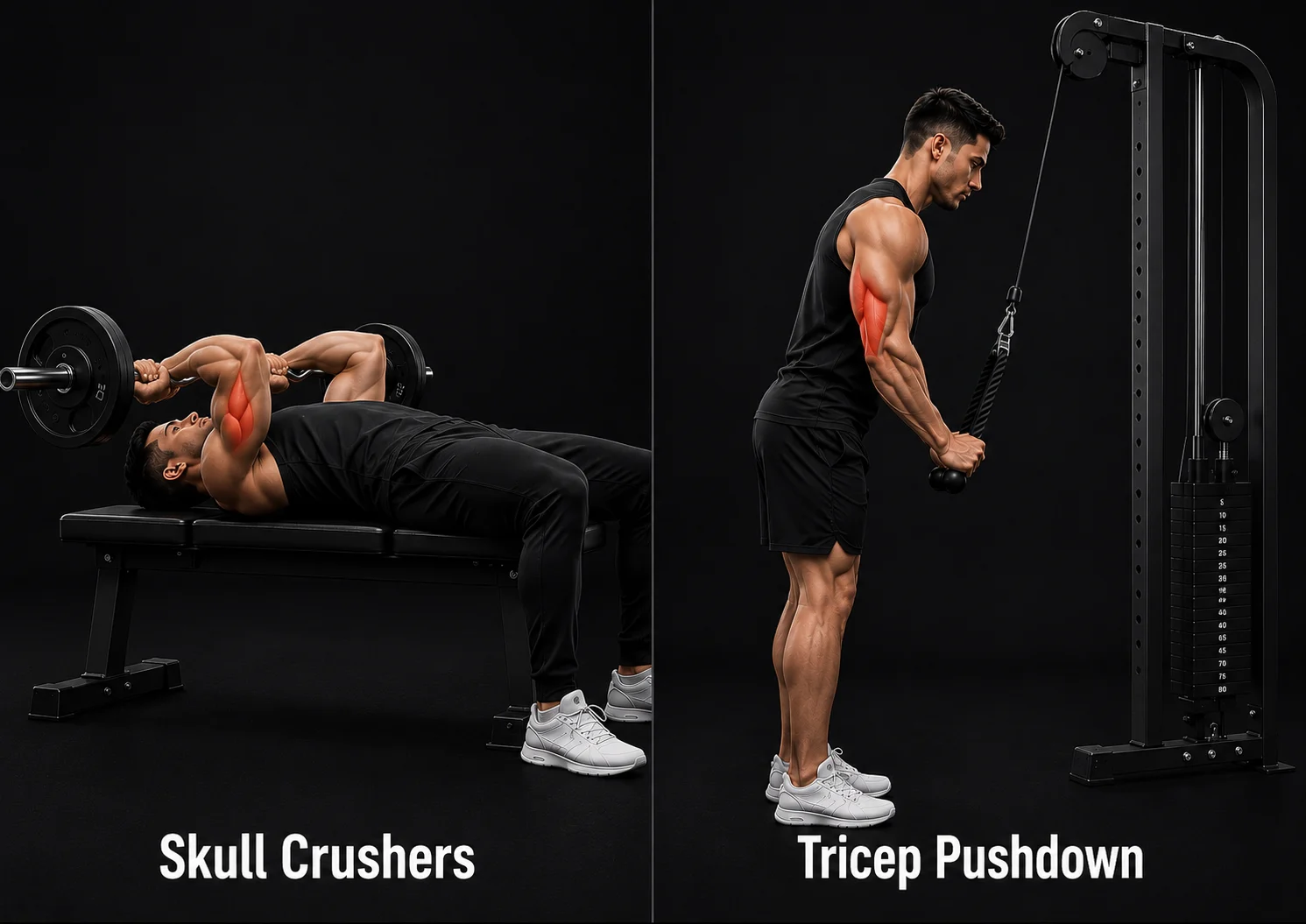
Skull crushers vs tricep pushdown side-by-side exercise comparison

Skull crushers (lying triceps extension) are performed lying on a bench, lowering a barbell, EZ bar, or dumbbells toward the head or just behind it, then extending the elbows back to full extension. The lying position and deep stretch make it a powerful free-weight triceps builder.

Tricep pushdown is performed standing at a cable machine, pushing a bar or rope attachment down from a bent-elbow position to full extension while keeping the upper arms fixed at the sides. The cable’s guided path provides consistent tension throughout the movement.

Neither exercise has a dedicated guide on this site yet — both are staple triceps accessories in most pushing-focused training programs.

My (author) personal take: I rotate both into an 8-week arm block rather than picking one permanently. Skull crushers went in first, on a strength day with an EZ bar to protect the wrists, capped at 4 sets of 6-8 reps because the elbow strain builds up fast past that range. Tricep pushdown went on a second, lighter session at 3 sets of 12-15 with a rope attachment for the extra stretch at the bottom. After 8 weeks, elbow discomfort was consistently lower on pushdown days, which lines up with why most physical therapists lean toward cable work for anyone managing existing elbow issues.

Muscles Worked

Both exercises target all three heads of the triceps brachii as the primary mover. Skull crushers, due to the overhead-style stretch position, tend to emphasize the long head particularly well. Tricep pushdown, with its more fixed elbow position, tends to emphasize the lateral and medial heads slightly more, though all three heads are involved in both exercises.
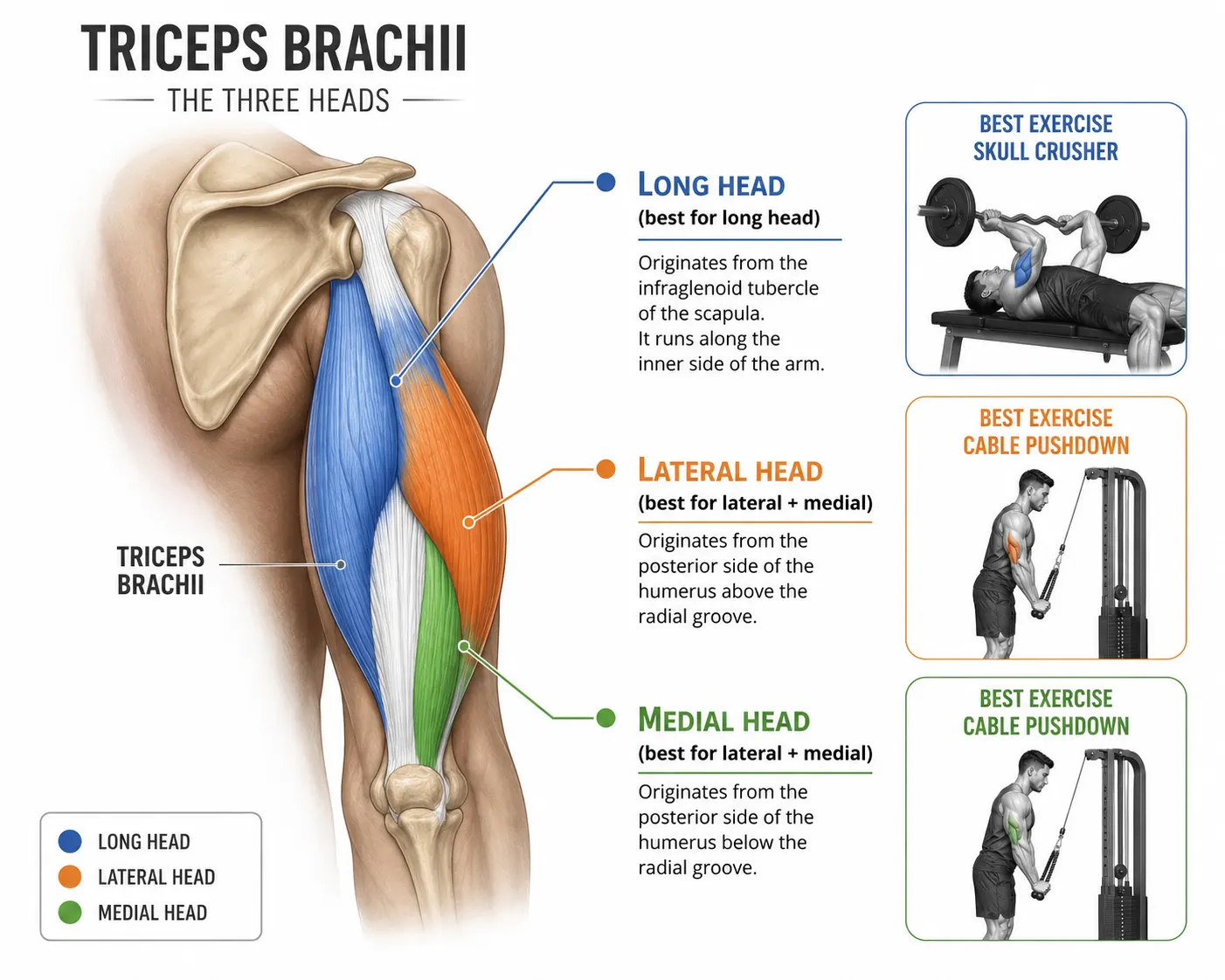
Triceps muscle anatomy showing long head, lateral head and medial head emphasis for skull crusher vs tricep pushdown

Strength Development

Skull crushers allow heavier absolute loading since they use free weights (barbell, EZ bar, or dumbbells), making them a strong choice for triceps strength development. Tricep pushdown is limited by cable stack loading and grip strength, making it more of a hypertrophy and endurance-focused exercise than a maximal strength builder.
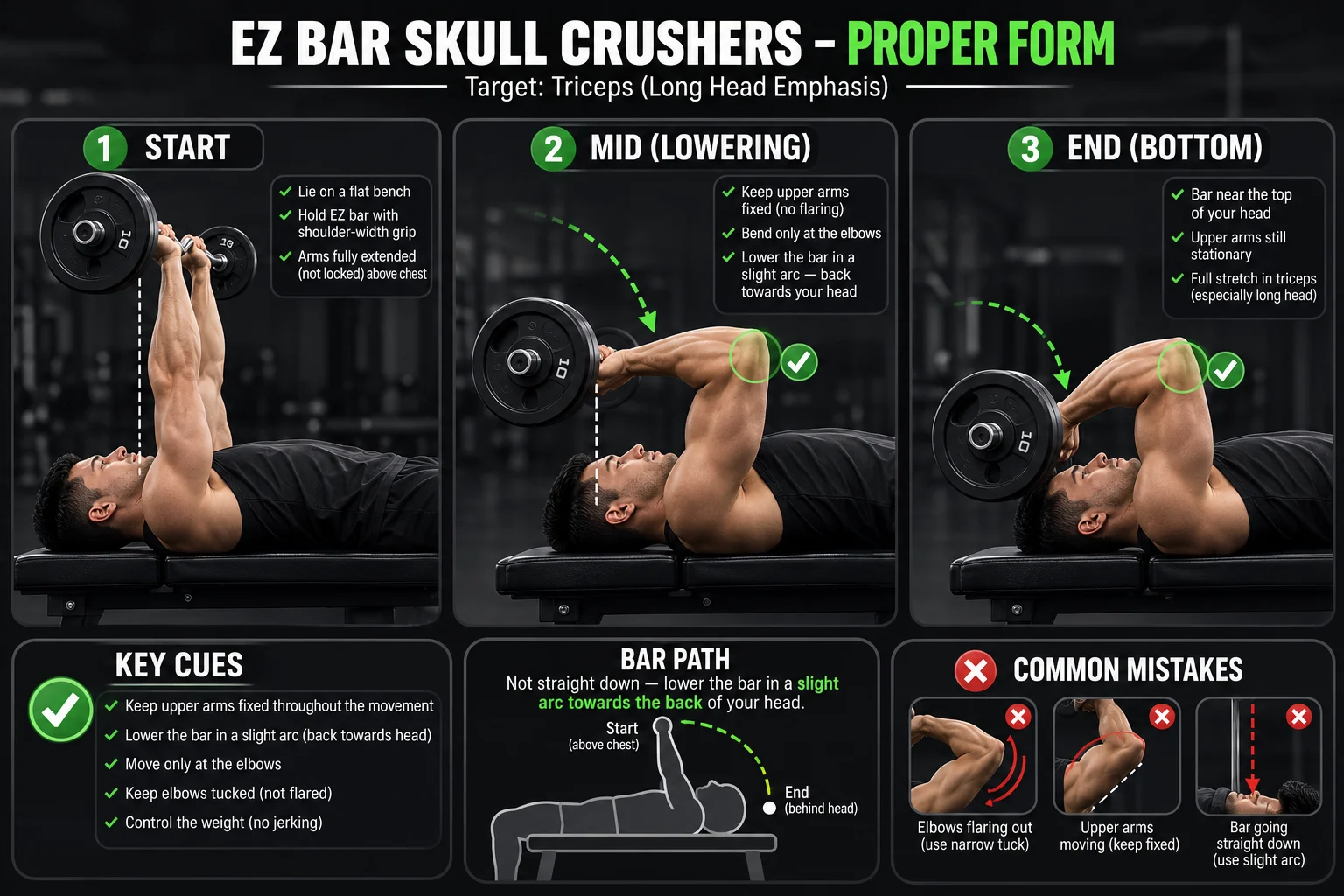
Proper skull crusher form with EZ bar showing safe bar path and elbow position

Muscle Growth

Both are excellent for triceps hypertrophy. Skull crushers’ deep stretch position is particularly effective for long head growth, since training a muscle in a lengthened position is strongly linked to greater hypertrophy. Tricep pushdown’s constant cable tension provides an excellent, consistent stimulus throughout the entire range of motion, making it a reliable volume-builder with lower joint stress.
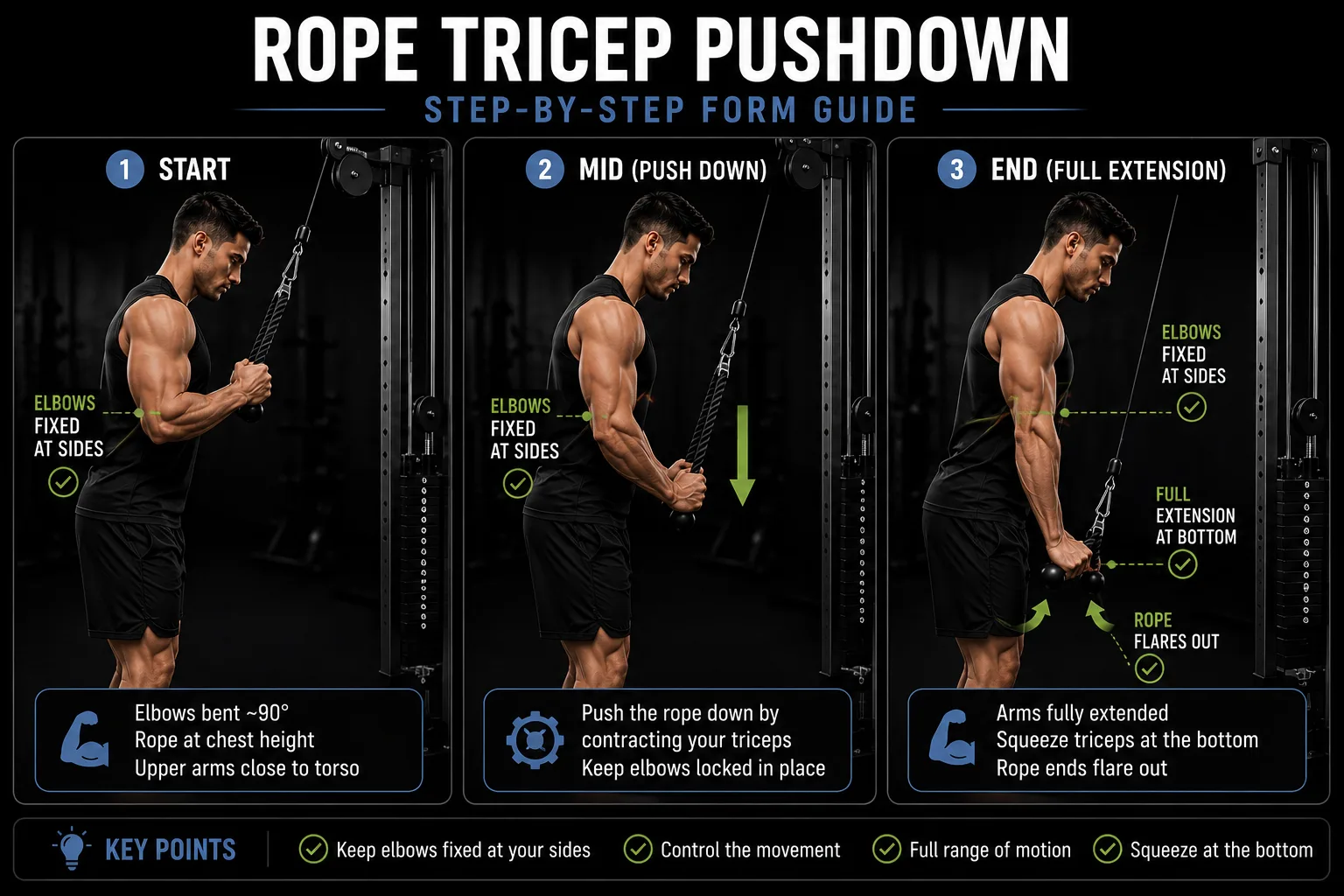
Tricep pushdown proper form with rope attachment showing elbow position and full range of motion

Beginner Friendliness

Tricep pushdown is more beginner-friendly due to its simple, guided cable path and lower technical demand. Skull crushers require more careful attention to bar path and weight selection, making them a better fit once a lifter has built some experience with triceps isolation training.

Safety

Tricep pushdown is generally the safer option long-term due to its controlled, predictable cable path and lower elbow stress. Skull crushers carry a higher injury risk if performed with poor bar path control, too much weight, or an uncomfortable wrist angle — using an EZ bar and moderate loading significantly reduces this risk.

Programming

Use tricep pushdown as a reliable, joint-friendly triceps accessory in the 10-15 rep range, 1-3 times per week. Include skull crushers when you want additional stretch-focused stimulus for triceps mass, using an EZ bar and controlled tempo in the 8-12 rep range.
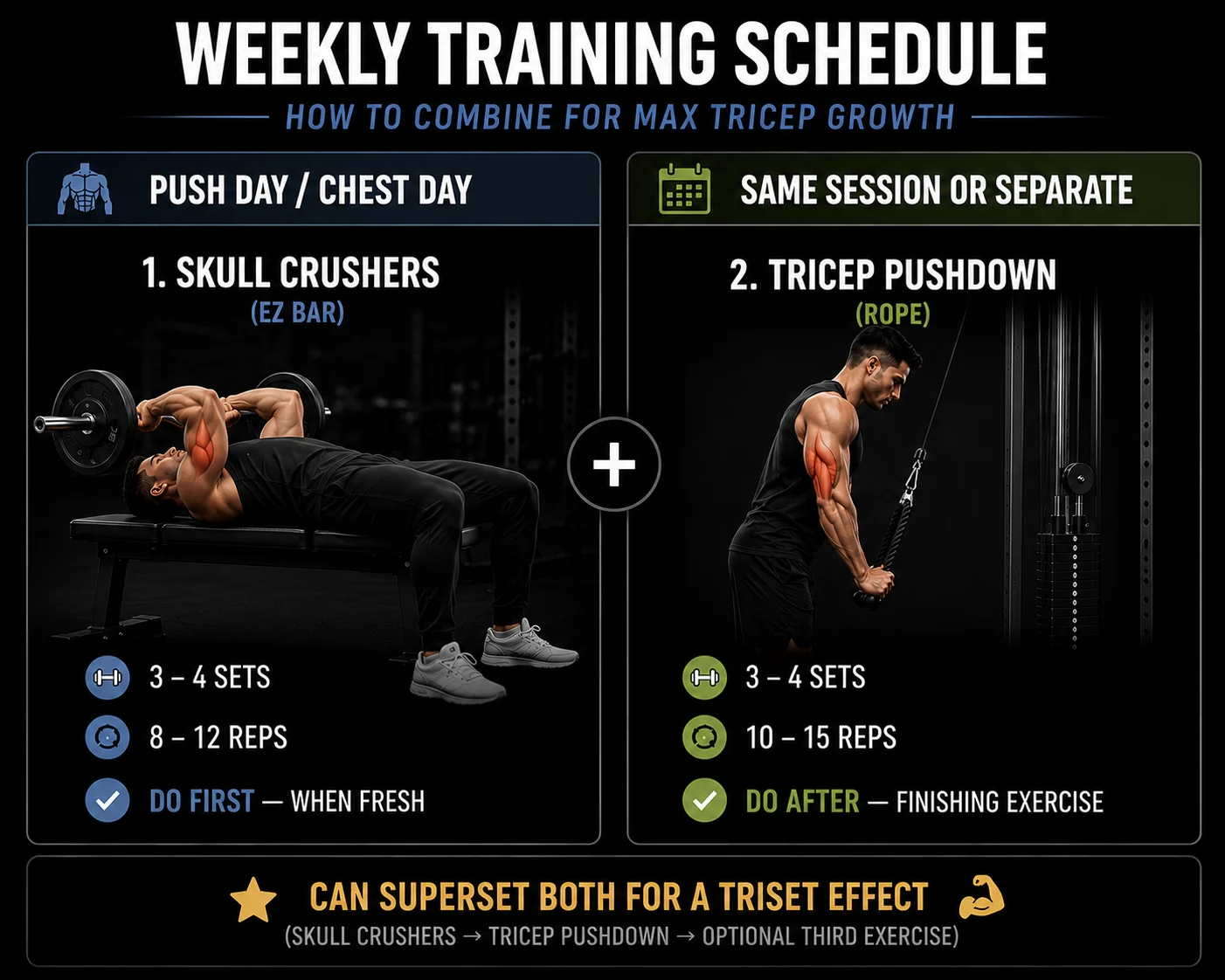
Weekly triceps training programming example combining skull crushers and tricep pushdown for maximum growth

Common Mistakes

Skull crusher mistakes: flaring the elbows out during the movement and lowering the weight too close to the forehead. Fix these by keeping the elbows fixed and pointed toward the ceiling, and lowering the weight to just behind the head instead.

Tricep pushdown mistakes: letting the elbows drift away from the sides and using body weight/momentum to push the weight down. Fix these by keeping the elbows pinned to the torso and controlling the movement through a full, deliberate range of motion.


Frequently Asked Questions

Skull crushers vs tricep pushdown: which is better for triceps growth?

Both are excellent triceps builders. In the skull crushers vs tricep pushdown matchup, skull crushers provide a deeper stretch particularly effective for the long head, while tricep pushdowns provide constant tension and are easier on the elbows. Most lifters benefit from including both.

Tricep pushdown vs skull crushers: is there a meaningful difference?

Yes. When comparing tricep pushdown vs skull crushers, the key differences are stimulus type (constant cable tension vs stretch-loaded free weight) and elbow stress (pushdown is gentler). Tricep pushdown vs skull crusher is less about which is better and more about which stimulus you're missing in your current routine.

Tricep pushdown vs skull crusher: which should I do first in a workout?

When pairing tricep pushdown vs skull crusher in the same session, do skull crushers first while you're fresh, since they require more bar path control and carry higher injury risk when fatigued. Then follow up with tricep pushdown as a finishing exercise.

Are skull crushers bad for the elbows?

They can be if performed with poor bar path control or too much weight — the deep stretch position places significant stress on the elbow joint. Using an EZ bar and controlling the weight carefully reduces this risk considerably.

Why do tricep pushdowns feel easier on my elbows than skull crushers?

The cable's fixed, guided path keeps tension more consistent and predictable, avoiding the deep stretch and momentary loading spikes near the head that make skull crushers riskier for the elbow joint.

Can I do skull crushers with dumbbells instead of a barbell?

Yes, dumbbell skull crushers are a common variation that allows a more natural wrist path and can reduce elbow strain slightly compared to a fixed barbell.

What attachment is best for tricep pushdown?

A rope attachment allows a slightly greater range of motion and lets you flare the hands out at the bottom for extra triceps contraction, while a straight bar allows heavier loading with a more fixed path.

Should beginners do skull crushers?

Beginners should approach skull crushers cautiously, starting with light weight and an EZ bar, or begin with tricep pushdowns first to build comfort with triceps isolation training before progressing to skull crushers.

Why do skull crushers build the long head of the triceps so well?

The overhead-style stretch position at the bottom of a skull crusher lengthens the long head of the triceps significantly, and training muscles in a stretched position is strongly linked to greater hypertrophy for that muscle head.

Can tricep pushdown build the same amount of triceps mass as skull crushers?

Yes, with sufficient volume and progressive overload, tricep pushdown can build substantial triceps mass, though it may emphasize the lateral and medial heads slightly more than the long head compared to skull crushers.

What's the safest way to perform skull crushers?

Use an EZ bar for a more comfortable wrist angle, lower the weight to just behind the head (rather than directly toward the forehead), and use a controlled tempo throughout, avoiding excessively heavy weight.

How many sets of triceps work should I do per week?

6-12 total weekly sets across triceps exercises is a common range for meaningful growth, adjusted based on your overall pushing and pressing volume.

Can I superset skull crushers and tricep pushdowns?

Yes, this is a common and effective way to combine the stretch-focused benefits of skull crushers with the constant-tension benefits of tricep pushdown in the same workout.

Is tricep pushdown a compound or isolation exercise?

It's an isolation exercise, targeting only the triceps through elbow extension with no significant involvement from other major muscle groups.

Why does my elbow click during skull crushers?

This can happen due to the joint moving through a large range of motion under load; if it's painless, it's often not concerning, but persistent pain or clicking warrants reducing weight or switching to tricep pushdown instead.

Can I do skull crushers without a bench?

Yes, some lifters perform them on the floor or on a stability ball, though a flat bench is the most common and stable setup.

Which is better for elbow rehab or coming back from an injury — skull crushers or tricep pushdown?

Tricep pushdown is generally the safer, more controlled choice when returning from an elbow issue, since the cable's guided path reduces sudden loading stress compared to a free-weight skull crusher.

Raaj, author of SleetGymTracker blog

Raaj

Hi, I am Raaj, the author of this blog. I have been into fitness for 7 years and have trained over 40 people in-person, mostly complete beginners. I started lifting at 17 with zero idea what I was doing and spent years figuring out what actually works. Everything I write comes from that experience. I built SleetGymTracker because I wanted a tracker that takes progressive overload seriously, and a blog that gives straight answers without the fluff. If something is unclear or you want to reach out, contact me at raaj@sleetgymtracker.com

Track Whichever One You Choose With Sleet

Whether you go with Skull Crushers or Tricep Pushdown, Sleet logs every set, rep, and weight automatically, so you always know exactly when to add weight next — no spreadsheet required.

Get it on Google Play