Introduction
Somewhere along the way, “8-12 reps for hypertrophy, 3-5 reps for strength” became gym gospel. It’s not wrong, exactly, but it’s incomplete, and treating it as an absolute rule causes a lot of lifters to needlessly restrict how they train.
Here’s what the research on rep ranges and muscle growth actually shows, and how to use it to build a smarter, more flexible training approach.
Muscle Growth Happens Across a Wide Rep Range
Multiple studies comparing low-rep (3-5), moderate-rep (8-12), and high-rep (20-30+) training, all taken close to failure with equated volume, find broadly similar muscle growth outcomes. The mechanism driving hypertrophy (mechanical tension applied to a muscle across enough total volume, with adequate effort) can be achieved at very different rep counts.
This means the question isn’t really “which rep range builds muscle”, nearly all of them can. The better questions are: which range builds the specific adaptation you want (strength vs. muscle endurance vs. muscle size), and which range fits your joints, schedule, and preferences best when your goal is building muscle.
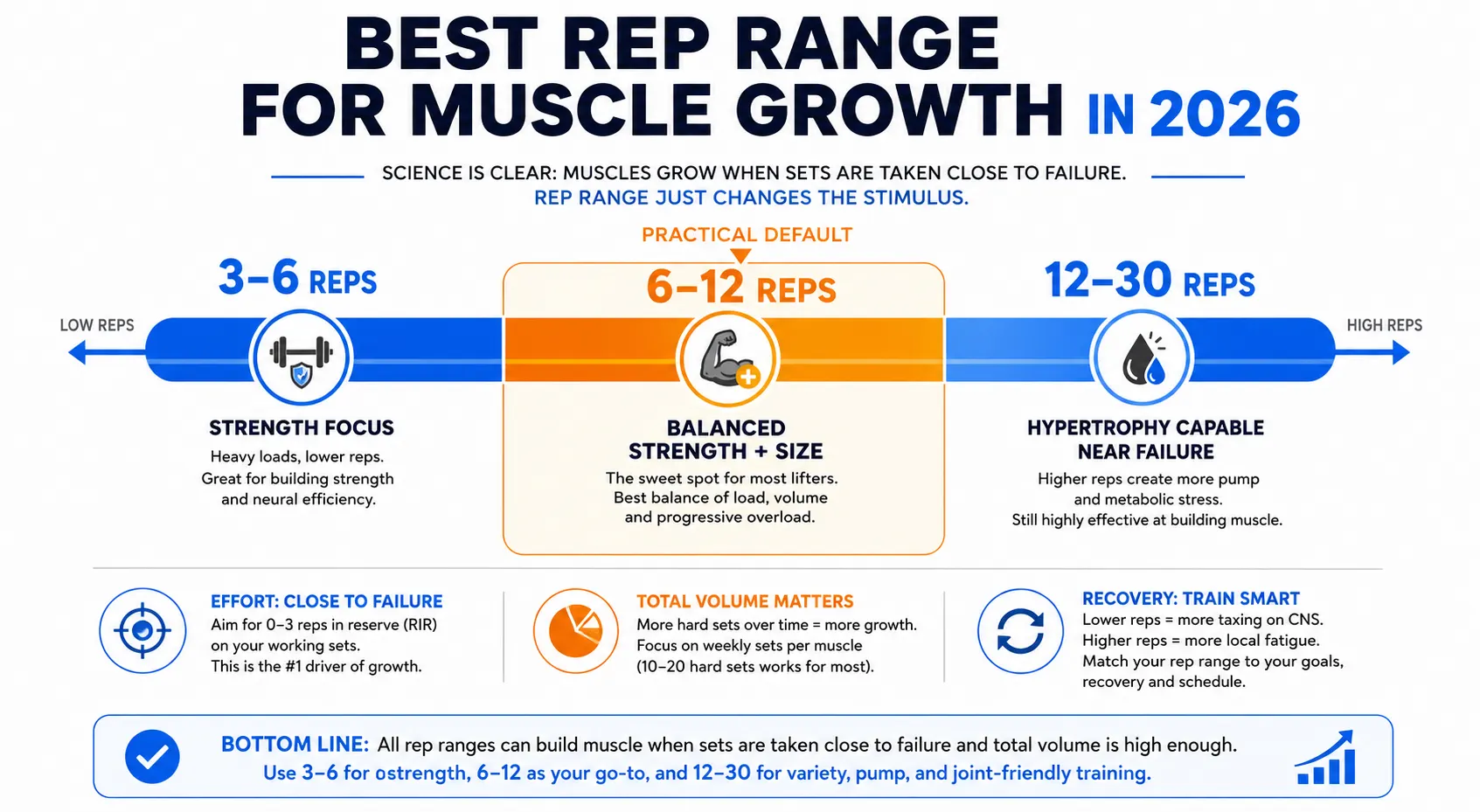
Rep range spectrum: muscle growth is possible across low, moderate, and high reps when effort is high enough.
Where Rep Range Actually Does Matter: Strength
If your primary goal is maximal strength (a bigger 1-rep max), lower reps at higher intensities matter more than they do for pure size:
- Neural adaptation: heavy singles, doubles, and triples build coordination and confidence with near-maximal loads that higher-rep training doesn’t directly practice.
- Specificity: a 1RM test is, definitionally, a 1-rep effort. Training at or near that rep count transfers more directly to the test itself.
This is why powerlifting-focused programs emphasize low reps at high percentages for main lifts, even though moderate or higher reps could build comparable muscle mass.
A Practical Framework for Choosing Your Rep Range
| Goal | Suggested Rep Range | Why |
|---|---|---|
| Maximal strength | 3-6 reps at 80-90%+ of 1RM | Neural practice with heavy loads, high specificity to strength tests |
| Muscle growth (general) | 6-12 reps | Efficient balance of volume accumulation and manageable fatigue per set |
| Muscle growth (joint-friendly) | 12-20 reps | Lower joint stress per rep while still reaching near-failure |
| Muscle endurance / metabolic work | 15-30 reps | Higher fatigue tolerance training, useful for accessories and time-limited sessions |
Most well-designed programs don’t pick just one row, they blend them. Main compound lifts often sit in the 4-8 rep range for strength and skill practice, while accessories and isolation work use 10-20 reps to accumulate training volume with less joint wear.
For core isolation, cable crunches are a useful example of an exercise that usually performs best in moderate-to-higher rep ranges with strict control.
For chest isolation specifically, this is the exact rep range where cable fly and pec deck usually perform best. If you are choosing between them, use this comparison.
How Strong Is the Evidence on Rep Ranges?
The practical recommendations in this guide are built on a mix of meta-analyses, controlled training studies, and long-term coaching application. The key takeaway is consistent: hypertrophy can occur across a broad rep range when effort and volume are controlled.
That said, there are limits to the literature you should know:
- Many studies are short (6-12 weeks), which may not capture long-term adaptation.
- Some cohorts are narrow (often young trained men), so transfer to women, older adults, or complete beginners is not always perfect.
- “Volume equated” in research does not always match how people train in real gyms.
- Adherence and exercise quality are hard to standardize outside tightly controlled environments.
Bottom line: treat rep ranges as strong evidence-based ranges, not rigid rules. Use your training log and recovery trends to personalize within those ranges.
Rep Range Prescription Table (%1RM, RIR, and Rest)
Use this as a practical starting template, then adjust based on progress and recovery.
| Goal | Exercise Type | Reps | Approx %1RM | Target RIR | Rest Between Sets |
|---|---|---|---|---|---|
| Max strength | Main compounds | 3-6 | 80-90% | 1-3 | 2-4 min |
| Strength + size | Main compounds | 6-8 | 75-85% | 1-3 | 2-3 min |
| General hypertrophy | Compounds + accessories | 8-12 | 65-80% | 1-3 | 90-150 sec |
| Joint-friendly hypertrophy | Machines + isolation | 12-20 | 50-70% | 0-2 | 60-120 sec |
| Metabolic finisher | Low-risk movements | 15-30 | 30-60% | 0-2 | 45-90 sec |
If percentages feel too rigid day to day, use RPE vs RIR plus the RPE to Percentage Calculator to autoregulate loads.
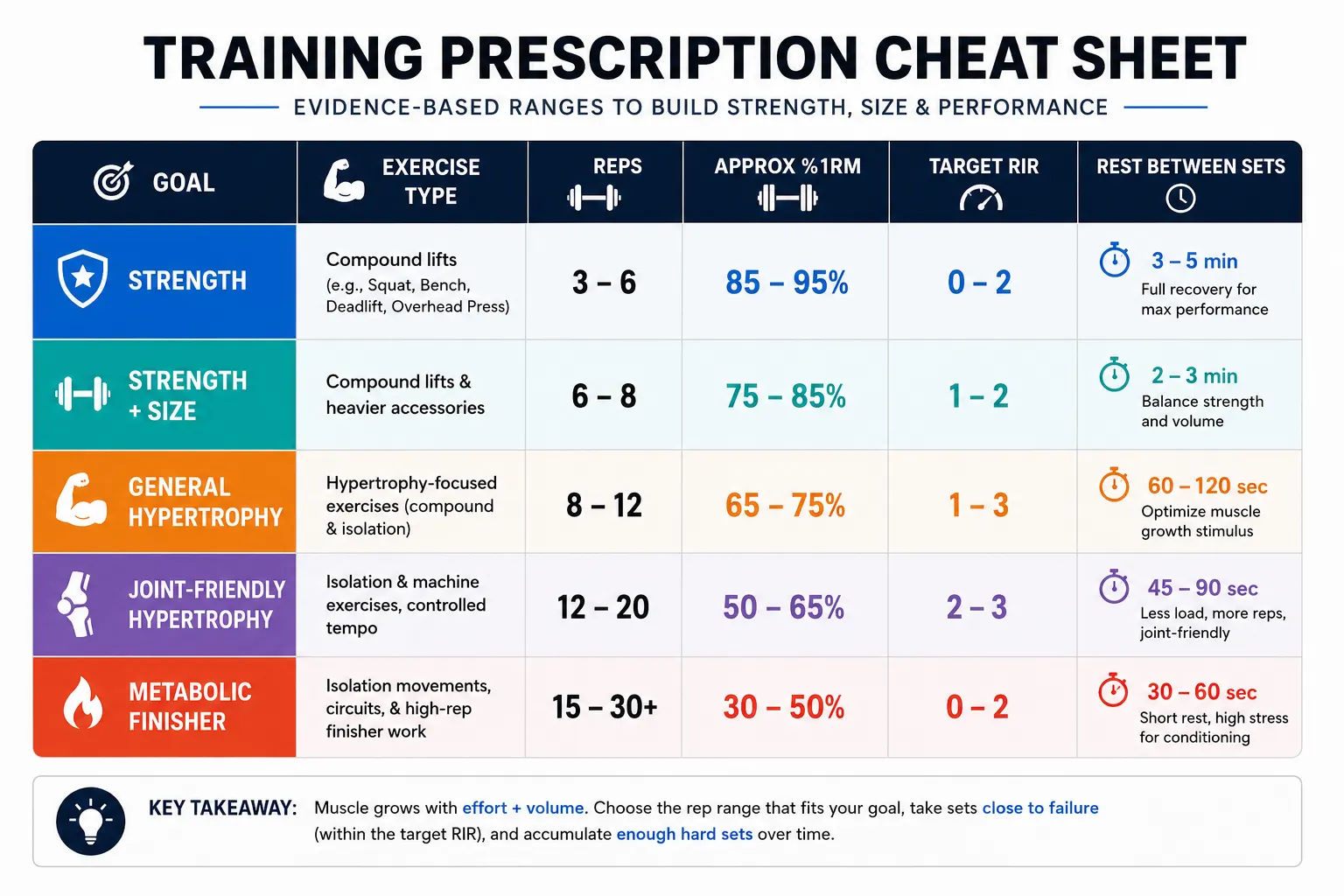
Quick implementation table: choose reps, load range, and rest based on goal and exercise type.
How to Find Your Best Rep Range in 4 Weeks
If you want personalization without overcomplicating your training, run this 4-week test.
Week 1-2: Moderate Emphasis
- Main compounds: 6-8 reps
- Accessories/isolation: 10-12 reps
- Keep sets at 1-3 RIR
- Log load, reps achieved, and session quality
Week 3-4: Slightly Higher-Rep Emphasis
- Main compounds: 8-10 reps
- Accessories/isolation: 12-15 reps
- Keep sets at 1-3 RIR
- Keep exercise selection and weekly set volume similar to Week 1-2
What to Track Each Week
- Performance trend (load or reps increasing)
- Recovery quality (sleep, soreness, readiness)
- Joint comfort
- Motivation and session consistency
How to Decide Your “Best” Range
Choose the block that gives you the best mix of:
- Upward performance trend
- Good recovery and lower irritation
- Better consistency and adherence
Then keep that range as your default for 6-8 weeks before retesting.
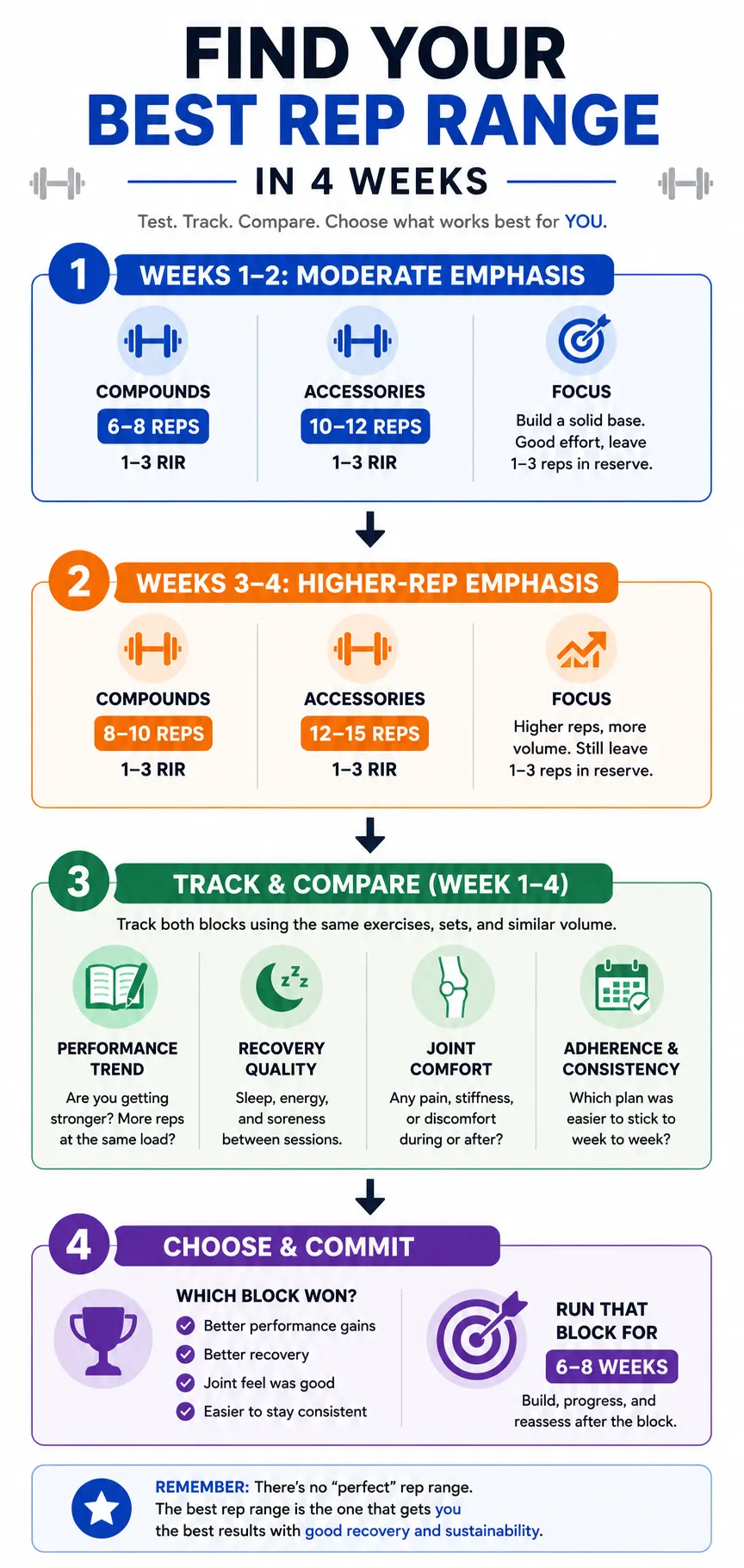
4-week self-test protocol: compare two rep-range blocks, then keep the one that delivers better progress and recovery.
Best Rep Range by Experience Level
Beginners (0-1 year of training)
The good news for beginners is that almost any rep range builds muscle. Newbie gains are driven primarily by neural adaptations, not the specific rep count. That said, starting with 8-15 reps is recommended because:
- Lighter loads at higher reps reduce injury risk while technique is still being learned.
- More reps per set means more practice with the movement pattern.
- Fatigue per set is manageable, making it easier to maintain form.
What beginners should do:
- Main lifts: 3 sets of 8-12 reps
- Accessory work: 3 sets of 10-15 reps
- Focus on adding reps before adding weight, this is progressive overload in practice (rep progression model)
- Do not rush to low-rep heavy lifting until technique is solid
Intermediate Lifters (1-3 years)
Intermediate lifters have exhausted most of their newbie gains and need more variety to keep progressing. This is when blending rep ranges becomes important.
What intermediates should do:
- Main lifts: 4-8 reps to build strength and reinforce technique with heavier loads
- Accessory work: 8-15 reps to accumulate total volume efficiently
- Rotate rep ranges every 4-6 weeks: for example, 4 weeks at 6-8 reps, then 4 weeks at 10-12 reps
- Track every session, at this stage progress slows and you need data to know you’re moving forward, especially if you feel not progressing
Advanced Lifters (3+ years)
Advanced lifters need structured block periodization to keep progressing. Using the same rep range indefinitely leads to adaptation and plateau.
What advanced lifters should do:
- Use block periodization:
- Accumulation block: 10-15 reps, high volume, moderate intensity
- Intensification block: 5-8 reps, lower volume, higher intensity
- Peak block: 1-5 reps, low volume, near-maximal intensity
- Regularly change rep ranges to prevent accommodation
- Use RPE to autoregulate, training by feel becomes more important than strict rep counts
- Deload every 4-6 weeks to manage accumulated fatigue
Best Rep Range by Exercise Type
Not all exercises respond the same way to rep ranges. Here is how to apply rep ranges based on the type of movement:
Compound Lifts
(Squat, Deadlift, Bench Press, Overhead Press, Barbell Row)
Recommended: 4-8 reps as primary work, 6-10 reps for volume sets.
Why: Compound lifts involve multiple joints and large muscle groups. Heavier loads with lower reps maximize mechanical tension on the target muscles. Heavy compound work also builds the strength base that carries over to all other training.
Specific recommendations:
- Squat: 4-6 reps for strength, 6-10 for hypertrophy focus
- Deadlift: 3-5 reps (high fatigue, keep volume lower)
- Bench Press: 4-8 reps primary, 8-12 for volume work
- Overhead Press: 5-8 reps primary, 8-12 for volume work
Isolation Exercises
(Bicep Curls, Lateral Raises, Tricep Pushdowns, Leg Curls, Cable Flyes)
Recommended: 10-20 reps.
Why: Isolation exercises target smaller muscle groups with less joint involvement. Going very heavy on isolation work increases injury risk (especially elbows and shoulders) without meaningful additional benefit. Higher reps allow you to reach failure safely and accumulate volume efficiently.
Specific recommendations:
- Lateral Raises: 12-20 reps
- Bicep Curls: 10-15 reps
- Tricep Pushdowns: 10-15 reps
- Leg Curls: 10-15 reps
- Cable Flyes: 12-20 reps
Machine Exercises
(Leg Press, Chest Press Machine, Seated Row Machine, Hack Squat)
Recommended: 8-15 reps.
Machines provide a fixed movement path which makes higher reps safer and more controlled. They are also excellent for drop sets and high-volume accumulation at the end of a session.
Bodyweight Exercises
(Push Ups, Pull Ups, Dips, Bodyweight Squats)
Rep range is less relevant for bodyweight exercises, progression comes from using harder variations, not adding reps indefinitely.
- Under 5 reps: move to an easier variation
- 5-15 reps: your working range
- Over 20 reps: progress to a harder variation
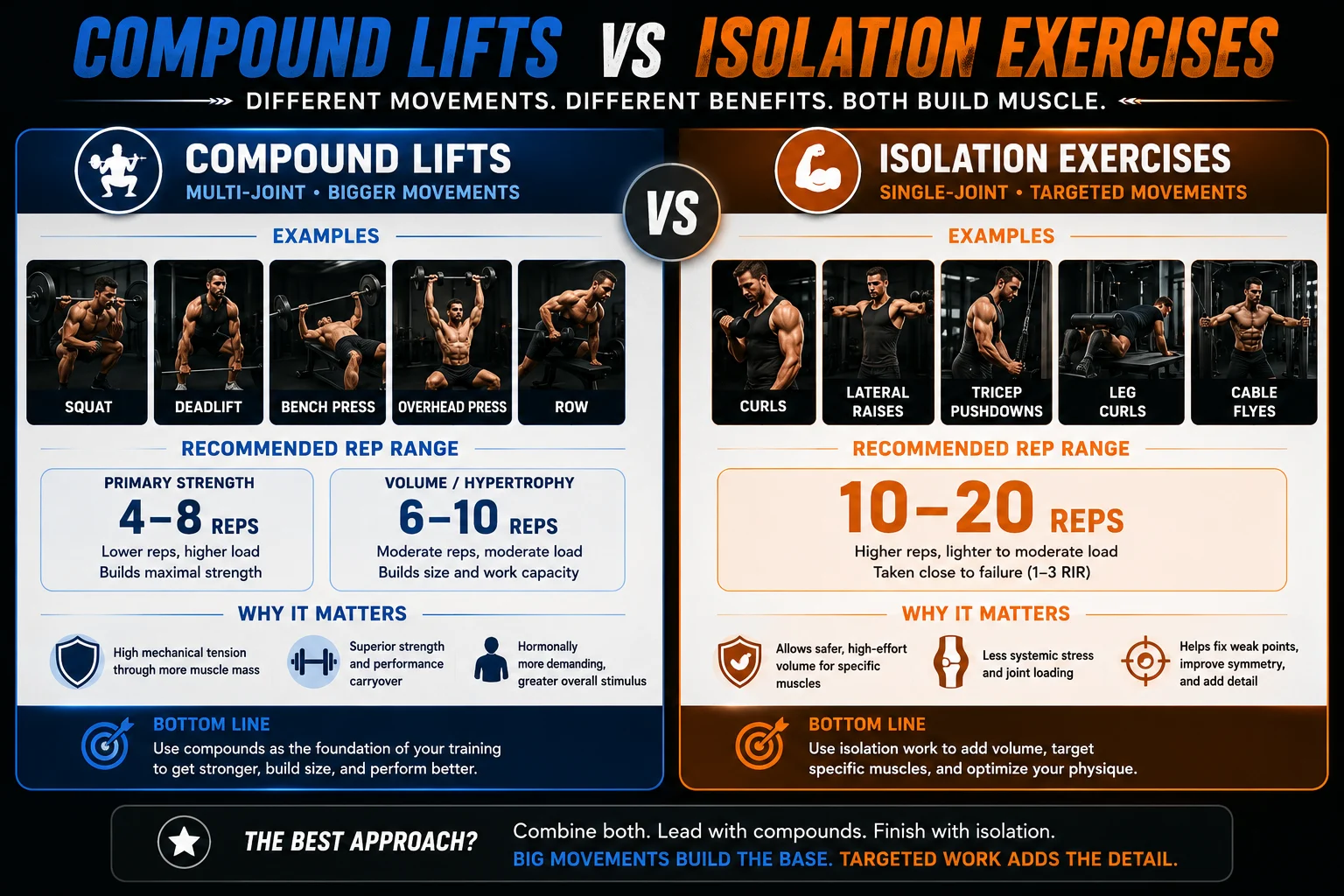
Compound vs isolation: use lower-to-moderate reps for heavy compounds and moderate-to-higher reps for most isolation work.
What Rep Range Should You Use When Cutting or Losing Fat?
This is one of the most searched questions about rep ranges and one of the most misunderstood.
The short answer: rep range does not directly burn fat. A calorie deficit is what drives fat loss, not the number of reps you perform.
However, rep range does affect muscle retention during a cut:
- Keep reps in the 6-15 range to maintain strength signals that tell your body to preserve muscle mass.
- Do not switch to very high reps (20-30) thinking it burns more fat, it does not, and it can increase session fatigue without better muscle retention.
- Do not drop to very low reps (1-3) while cutting, recovery is compromised in a deficit and injury risk increases.
- Maintain the same rep ranges you use when building, just reduce volume slightly if recovery is suffering.
The goal during a cut is to give your body a reason to hold onto muscle. Training the same way you do when building (just with slightly less volume) is the most effective approach.
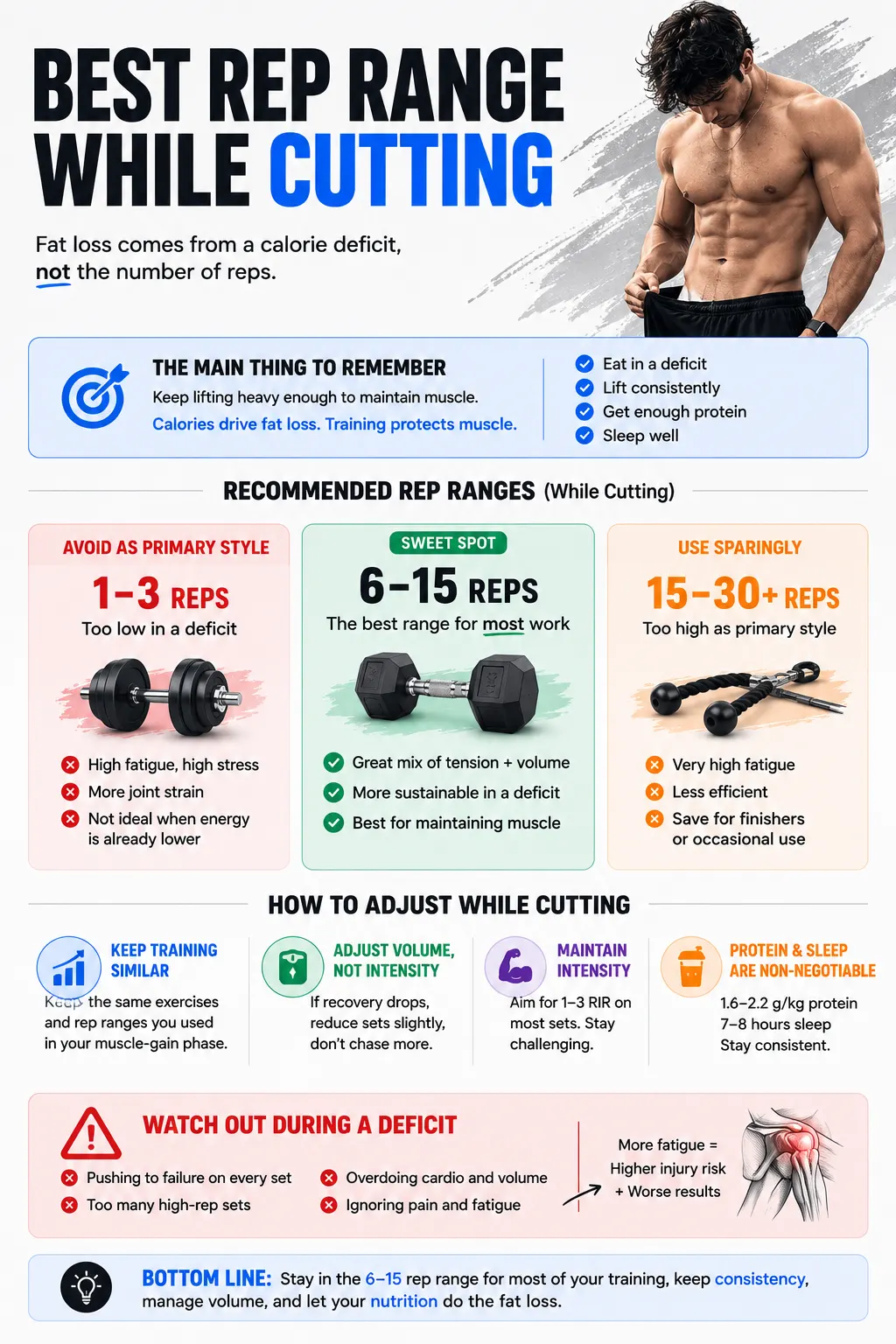
Cutting guideline: preserve strength and muscle signals with moderate reps while managing recovery and fatigue.
Common Mistakes
- Believing 8-12 reps is the “only” hypertrophy range. It’s a good practical default, not a biological requirement.
- Doing high-rep sets nowhere near failure. A 20-rep set stopped at rep 12 isn’t a real hypertrophy stimulus, it’s a warm-up.
- Using only 1-5 reps for every exercise, including accessories. This maximizes joint stress and fatigue for isolation movements that don’t need to be trained that heavy.
- Never varying rep range across a training block. Cycling rep ranges (e.g., a “strength block” then a “hypertrophy block”) can help manage joint stress and keep training engaging.
- Ignoring how close to failure you’re actually training. Rep range without sufficient effort is the real reason many lifters think “higher reps don’t work for me.”
Practical Tips
- Use 4-8 reps for your main compound lifts (squat, bench, deadlift, overhead press) to build strength and reinforce heavy technique.
- Use 8-15 reps for most accessory and isolation work to accumulate volume efficiently with less per-rep joint stress.
- Reserve very high reps (20-30) for exercises where joint stress is low and you want a metabolic finisher (e.g., leg press, cable work, bodyweight movements).
- Whatever range you pick, train genuinely close to failure, leaving 1-4 reps in reserve on most working sets.
- Don’t be afraid to rotate rep ranges across training blocks; it keeps joints fresh and training mentally engaging.
- Use a Progressive Overload Calculator to track your progress when rotating rep ranges.
- If you want to calculate your weekly volume, track your sets per muscle group across the whole week rather than only per workout.
Calculator Integration
Once you settle on a rep range, especially for lower-rep strength work, it helps to know your actual working percentages. The One Rep Max Calculator estimates your 1RM from a recent set, and the RPE to Percentage Calculator converts a target effort level into an approximate load, so a “4-6 reps at 85%” prescription becomes a real number on the bar instead of a guess.
Summary
- Muscle growth can occur across a wide rep range (roughly 5-30 reps) when sets are taken close to failure.
- Lower reps (3-6) at higher intensities are specifically better for building maximal strength due to neural and specificity factors.
- 6-12 reps remains a smart practical default for most lifters and most exercises, not because it’s uniquely superior for growth, but because it balances multiple goals well.
- Effort (proximity to failure) matters more than the exact rep number for driving hypertrophy.
- Blend rep ranges across your program: lower reps for main lifts, moderate-to-higher reps for accessories.