Every Feature.
One Free App.
A complete breakdown of everything Sleet does, the best free gym tracker for Android lifters.
What Sleet Includes
Every feature built specifically for gym goers who want to track sets, beat plateaus, and make real progress.
CORE FEATURE
Gym Log Tracker
Every serious gym workout tracker starts with one thing done right: logging sets without friction. Sleet lets you record weight, reps, and sets in a single tap. No multi-screen flows, no unnecessary confirmations.
The moment you open an exercise, you see exactly what you lifted last session. That instant reference is what separates a useful workout tracker from one that wastes time between sets.
- 10 muscle groups: Chest, Back, Shoulders, Biceps, Triceps, Legs, Glutes, Core, Full Body, Cardio
- Log weight (kg) and reps for strength exercises
- Log distance (km) and duration for cardio
- Edit or delete any set or full session after the fact
- Previous session data visible instantly, no digging required
- Offline-first: all data stored locally on your device
Research consistently shows that people who track their workouts progress faster than those who train by feel. A 2019 analysis in the Journal of Strength and Conditioning Research found that systematic load tracking was one of the strongest predictors of adherence to progressive overload principles. Learn more about why logging matters in our guide to progressive overload tracking.
HANDS-FREE
Voice Logging
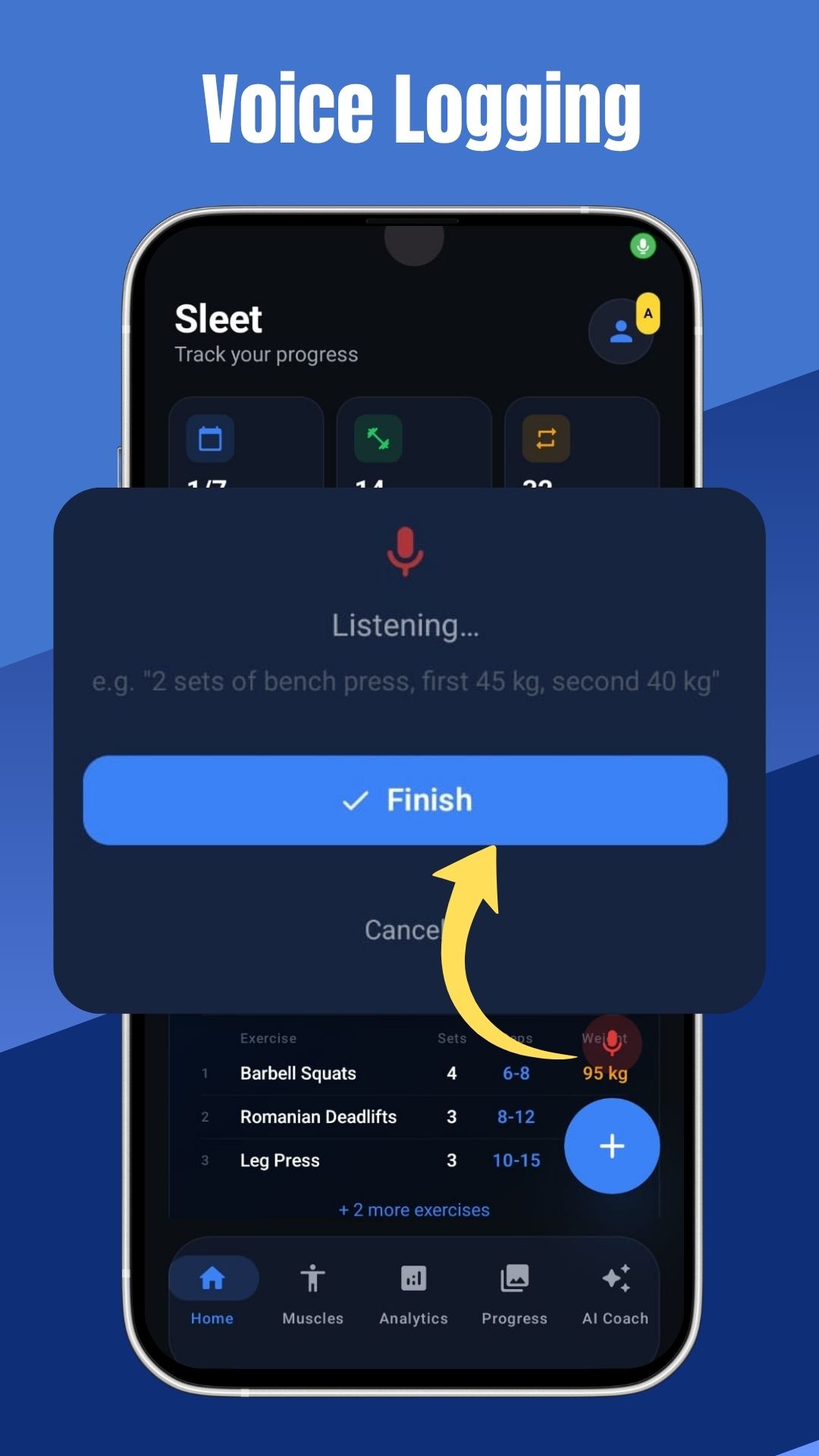
Typing between sets breaks focus. Sleet's voice logging lets you speak your workout in plain language and the app handles the rest.
Tap the mic button, say something like "bench press, 3 sets of 8 at 80 kilos", and Gemini AI extracts the structured data in real time. A confirmation sheet appears so you can review and edit before anything is saved. Nothing gets logged without your approval.
- Supports English and Hindi
- Continuous listening with live partial transcript on screen
- Powered by Gemini 2.5 Flash for fast, accurate extraction
- Editable confirmation sheet before saving
- Free to use, no paywall on voice logging
Voice logging is especially useful for high-rep sets, supersets, or any session where you need to stay in the zone. Gym tracker Reddit threads regularly mention hands-free logging as a top request, Sleet solves it without a subscription.
POWERED BY GEMINI
AI Coach
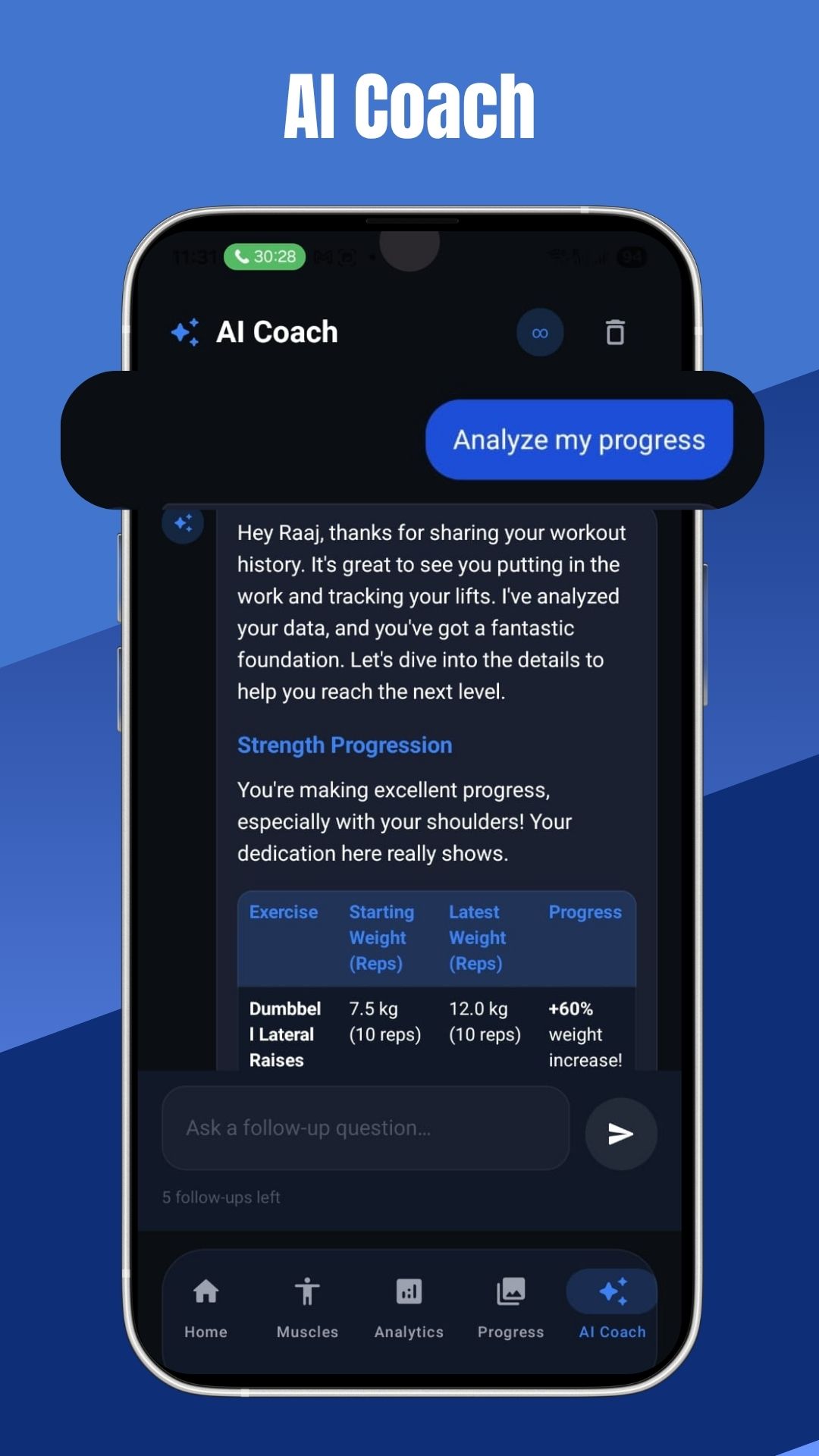
Most lifters never work with a personal coach. The AI Coach in Sleet changes that. It reads your full workout history before answering a single question, so it already knows what you've been lifting, where you've stalled, and what your recent training looks like.
Ask anything about your training: "Why am I not progressing on deadlifts?", "Should I deload this week?", "Am I training chest enough?". The AI Coach answers in full context, not generic advice copy-pasted from a fitness blog.
- Multi-turn conversation, follow up with more questions
- First message auto-includes your complete workout history as context
- Fitness-only topic gate, stays focused on training
- AI-generated follow-up question suggestions
- Markdown responses with tables and structured breakdowns
- Free, no subscription required
The difference between generic fitness advice and coaching is context. Sleet's AI Coach has all your context. Read our article on what to look for in a gym tracker with an AI coach to understand what separates real coaching from chatbot fluff.
ADAPTIVE PLAN
AI Routine Planner
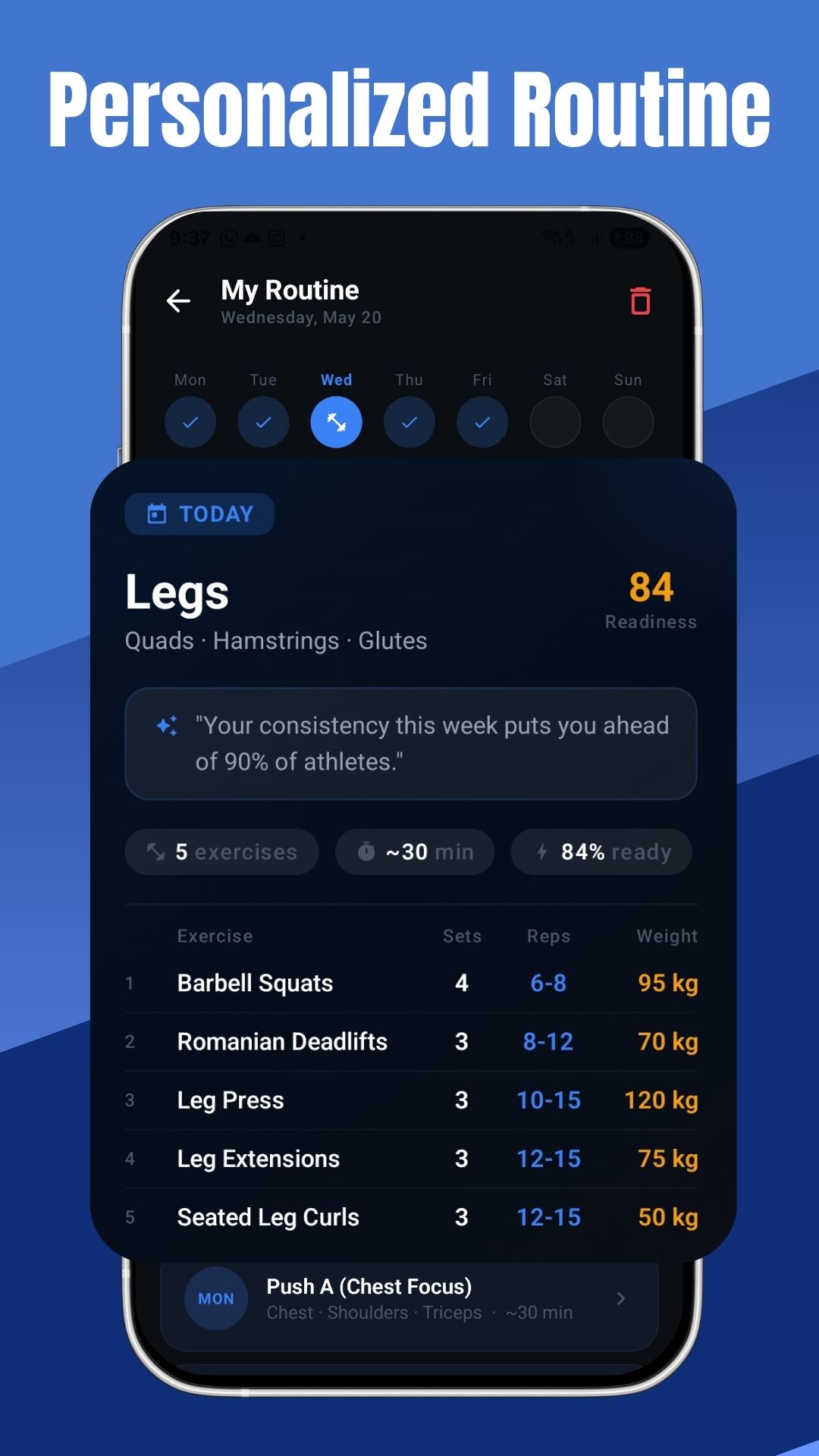
The AI Routine Planner generates a complete personalised weekly training program based on your actual performance data, not a generic template. It accounts for your current PRs, detected plateaus, muscle imbalances, recovery score, deload flag, and your stated goals.
Every day card in the plan includes: exercise selection, sets, rep range, target weight in kg, RPE target, and specific coaching notes. It is not a list of exercises, it is a structured, progressive training plan.
- Inputs: goal, available equipment, days per week, session length
- Uses your real plateau list and imbalance data when building the plan
- Day-by-day breakdown with exercise, sets, reps, weight, RPE, and coaching notes
- Regenerate the plan as your data changes
- Free, not behind a paywall
Writing a training program is one of the hardest things for gym beginners and intermediate lifters. The American College of Sports Medicine recommends progressive, periodized programs for optimal strength and hypertrophy adaptations. Sleet's planner applies those principles automatically. See how it compares to manual programming in our periodization for beginners guide.
SCIENCE-BACKED DETECTION
Plateau Detection
Most gym trackers just show you a line graph and expect you to figure out if you're stuck. Sleet does the analysis for you using real regression math, not a simple week-over-week comparison.
For every exercise with at least 6 logged sessions, Sleet calculates your estimated 1RM using the Epley formula for each session, then fits an ordinary least squares (OLS) linear regression to the last three weeks of data. The result is one of four states:
| Status | Condition | What it means |
|---|---|---|
| Progressing | Slope > 2.0 kg/week | Steady strength gain, keep going |
| Plateau | Slope < 0.5, low variance | Strength stuck, change stimulus |
| Regressing | Slope < 0 | Strength declining, investigate |
| Stagnating | Low slope, high variance | Inconsistent results, check recovery |
- Dismissible warning cards inside the app
- Push notifications when a new plateau is detected
- Deep links directly to the affected exercise
- Works across all 10 muscle groups and exercise categories
Plateau detection is meaningless without a fix. Read our full guide on breaking a bench press plateau and our general progressive overload mistakes article for actionable strategies.

INJURY PREVENTION
Muscle Imbalance Detection
Training volume imbalances between opposing muscle groups are one of the leading causes of overuse injuries and postural problems in gym goers. Most workout trackers show you volume numbers but leave you to interpret them alone.
Sleet automatically calculates three critical ratios from your logged training volume and flags imbalances with three severity tiers and specific corrective suggestions.
| Ratio Tracked | Why It Matters |
|---|---|
| Push : Pull | Shoulder health, posture, rotator cuff longevity |
| Quad : Hamstring | Knee stability, ACL injury risk reduction |
| Chest : Back | Thoracic spine health, rounded shoulders prevention |
- Three severity levels: mild, moderate, high
- Specific exercise suggestions to fix each imbalance
- Dismissible for 7 days per imbalance
- Updates in real time as you log more sessions
According to the NSCA's research on muscle imbalances, maintaining balanced ratios between antagonist muscle pairs significantly reduces injury risk in resistance-trained athletes. Sleet puts that monitoring on autopilot.

PROGRESS INTELLIGENCE
Analytics Dashboard
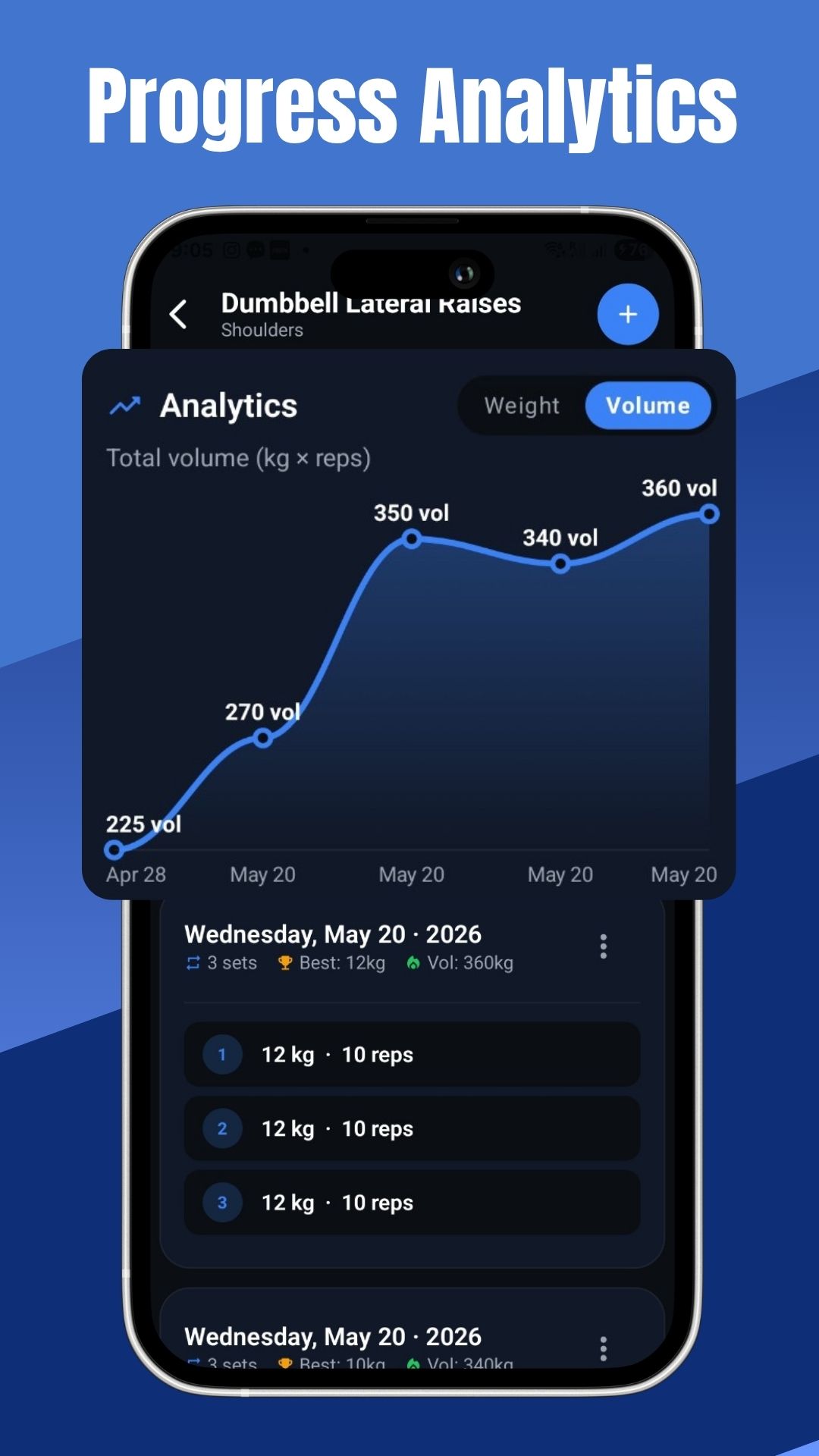
Raw numbers are not insight. The Sleet analytics dashboard turns your logged training data into a clear picture of where you stand, what needs attention, and how consistent you have been.
- Streaks, current streak and all-time best streak, so consistency has a score
- Experience Score, 0-100 score that maps to tiers: Beginner, Intermediate, Advanced, Elite
- Day-of-week activity chart, see which days you actually train vs which you plan to train
- Weakest and strongest muscle highlight, at-a-glance view of your training balance
- 4-week volume per muscle group, weekly sets per muscle tracked across the last month
Weekly training volume is one of the most evidence-backed variables in hypertrophy programming. Research summarized by Stronger By Science shows that tracking volume per muscle group across weeks is essential for progressive overload. The analytics dashboard makes this visible without any manual calculation. Use it alongside our free weekly training volume calculator.
VISUAL TRACKING
Progress Photo Gallery
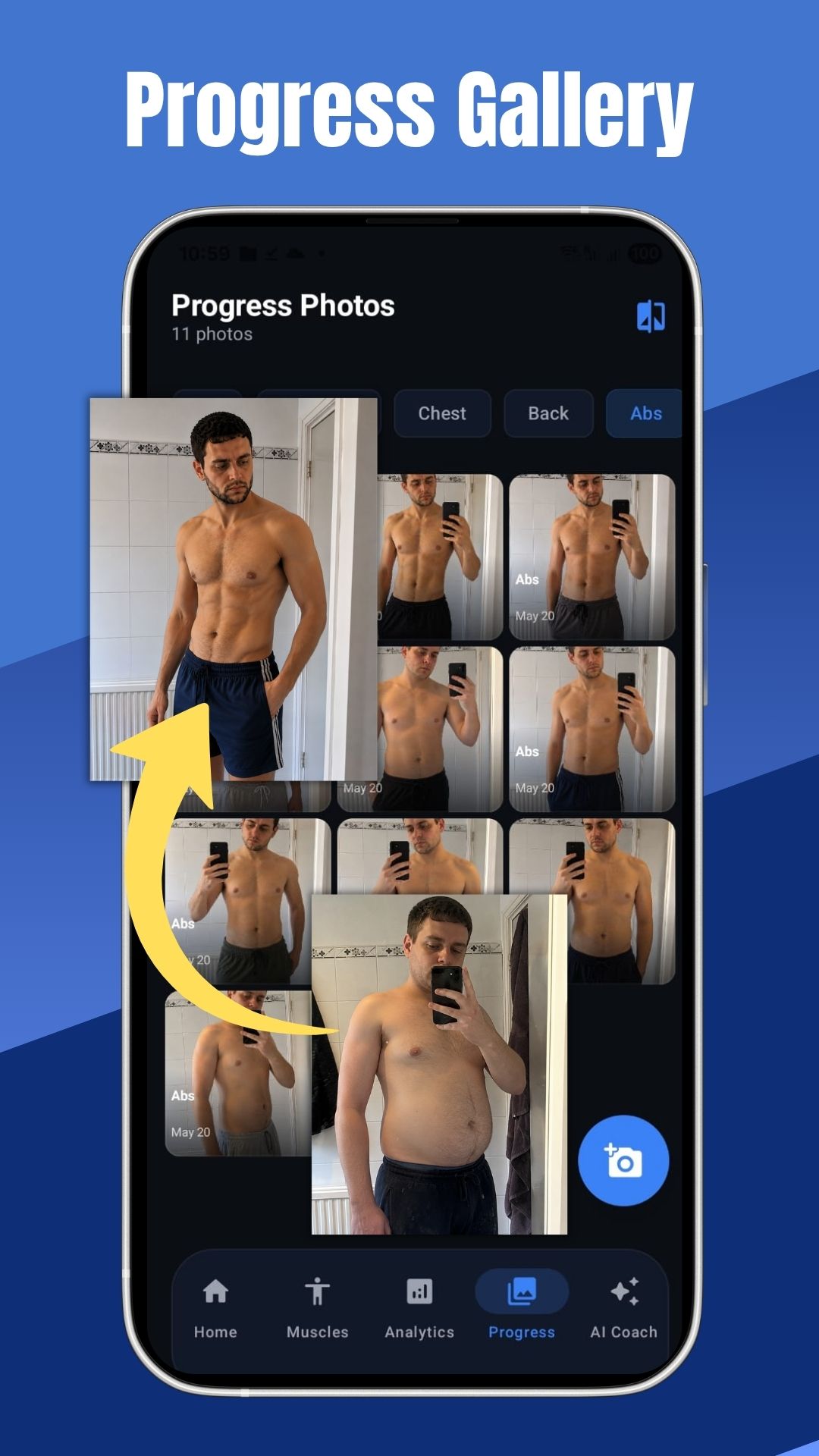
The scale lies. Body weight fluctuates daily based on water retention, food volume, and glycogen. Progress photos are often the only honest measure of actual body composition change over weeks and months.
Sleet's progress photo gallery is built directly into the gym tracker so your visual progress lives in the same app as your training data. No switching between apps, no cluttered camera roll.
- Capture photos directly in the app or import from your gallery
- Tag each photo by body part (front, back, side, arms, legs)
- Filter your gallery by body part
- Full-screen view for detail
- Side-by-side comparison mode, select any two photos to compare
Seeing visible change is one of the strongest psychological reinforcers of gym consistency. Keeping your photos inside the same app as your strength data means you can cross-reference visual progress with training milestones.
STAY ON TRACK
Smart Daily Notifications
Notification spam is one of the fastest ways to get an app deleted. Sleet uses a priority-cascade system: at most one notification per day, with a 23-hour anti-spam guard between alerts.
Each notification deep-links directly to the relevant screen in the app so you never have to hunt for what was flagged.
| Priority | Notification Type | When Triggered |
|---|---|---|
| 1 (Highest) | Deload Warning | Recovery score drops below threshold |
| 2 | High Imbalance Alert | A muscle ratio exceeds the HIGH severity threshold |
| 3 | Plateau Alert | An exercise is classified as plateau or regressing |
| 4 | Re-engagement | More than 3 days since last logged session |
| 5 (Lowest) | Streak Motivation | Default daily nudge when no higher-priority alerts exist |
This cascading system means the notification you receive is always the most important thing Sleet has to tell you. Never a generic "don't forget to work out" when your shoulder imbalance is at a critical ratio.

YOUR DATA, YOUR CONTROL
Backup and Restore
Years of training data has real value. Sleet gives you full control over your data with a complete backup and restore system that exports everything: your training database and all your progress photos.
- Export a ZIP file containing your full Room database and all progress photos
- Saved to your device storage, you own the file
- Restore from any previous backup with UID verification
- App restarts cleanly after a restore to ensure data integrity
- No cloud subscription required to access your own data
Most fitness apps lock your data behind their servers. When they shut down or change their terms, your history disappears. Sleet's local backup system means your years of gym set tracks stay on your device and under your control, regardless of what happens to any cloud service.

How Sleet Stacks Up
Feature-by-feature against the most popular gym tracking apps for Android.
| Feature | Sleet | Strong | Hevy | JEFIT |
|---|---|---|---|---|
| Gym log tracker | ✓ Free | ✓ | ✓ | ✓ |
| Voice logging | ✓ Free | ✗ | ✗ | ✗ |
| AI Coach | ✓ Free | ✗ | ✗ | Paid |
| AI Routine Planner | ✓ Free | Paid | ✗ | Paid |
| Plateau detection | ✓ Free | ✗ | ✗ | ✗ |
| Muscle imbalance detection | ✓ Free | ✗ | ✗ | ✗ |
| Progress photos | ✓ Free | Paid | ✓ | Paid |
| Full data backup/export | ✓ Free | Paid | ✗ | Paid |
| Android availability | ✓ | ✓ | ✓ | ✓ |
| Subscription required | No | Yes | Yes (some) | Yes |
For deeper comparisons, see: Sleet vs Strong, Sleet vs Hevy, Sleet vs JEFIT, Sleet vs Fitbod.
Frequently Asked Questions
Is Sleet gym tracker free?
Yes. Sleet is completely free on Android. Gym logging, voice logging, AI coach, AI routine planner, plateau detection, muscle imbalance detection, analytics, progress photos, and data backup are all free. There is no subscription or paywall on core features.
Does Sleet work offline?
Yes. All workout logging, session history, and analytics run fully offline. Data is stored locally on your device using a local database. AI features (voice logging, AI coach, AI planner) require an internet connection to reach the Gemini API.
How accurate is the plateau detection?
Plateau detection requires at least 6 logged sessions for an exercise before it activates. It uses the Epley formula to estimate your 1RM per session, then fits a linear regression to the last 3 weeks of data. This is significantly more reliable than a simple week-to-week comparison and avoids false positives from single bad sessions.
What language does voice logging support?
Voice logging currently supports English and Hindi. You can speak exercise names, sets, reps, and weight in natural language. The app shows a live transcript as you speak and lets you review the extracted data before saving.
Can I export my gym data?
Yes. Sleet lets you export a complete ZIP backup containing your full training database and all progress photos to your device storage. You can restore from any backup at any time. Your data stays on your device, no cloud lock-in.
Is Sleet available on iOS or Apple Watch?
Sleet is currently Android-only. It is optimised for Android with a native Kotlin and Jetpack Compose app. An iOS version is not available at this time.
How does the AI Routine Planner differ from a standard workout template?
A workout template is the same for every user. Sleet's AI Routine Planner generates a plan specific to you: it uses your current PRs, detected plateaus, muscle imbalances, recovery score, deload flag, and your stated goals to produce a weekly plan with specific sets, reps, target weights, and RPE values. It adapts as your data changes.
Further Reading from Trusted Sources
The features in Sleet are grounded in well-established exercise science. These are authoritative resources that informed the design of the tracking and analysis systems:
- Stronger By Science, Hypertrophy, rep ranges, and training volume evidence review, One of the most thorough analyses of volume and intensity research for muscle growth.
- Examine.com, Resistance Training Research Summary, Evidence-based summaries of the research on progressive overload, frequency, and hypertrophy.
- American College of Sports Medicine, Physical Activity and Strength Training Guidelines, Official evidence-based guidelines on resistance training frequency, volume, and progression.
- NSCA, Muscle Imbalances and Injury Prevention, Research on antagonist muscle ratios and their role in injury prevention for resistance-trained athletes.
- Renaissance Periodization, Training Volume Landmarks for Muscle Growth, Dr Mike Israetel's framework on minimum effective volume, maximum adaptive volume, and maximum recoverable volume, the basis for good tracking-driven programming.
Guides to Get More From Sleet
Use these to pair the app with proper training knowledge.
Every feature. Zero cost.
The most capable free gym tracker on Android. Voice log your sets, beat plateaus, and follow a plan built from your own data.