What Is Progressive Overload?
Progressive overload is the gradual, planned increase of stress placed on a muscle during training, over time. Your body adapts to the demands you place on it, and only to those demands. If you lift the same weight, for the same reps, the same way, for a year, your body has already adapted. There is no reason left for it to build more muscle or get stronger.
Think of it as a signal-response loop:
- You apply a training stimulus that is slightly harder than what your body is used to.
- Your body interprets this as a reason to adapt and handle it better next time.
- Given adequate recovery (sleep, food, time), your muscles and nervous system adapt.
- You repeat the process at a new, slightly higher level.
Miss any one of these steps and the loop breaks. This is why two people can follow the exact same program and get completely different results, one is consistently applying overload with good recovery, and the other is not.
For a shorter, plain-English introduction see our what is progressive overload guide.
The 6 Real Ways to Apply Progressive Overload
Most lifters only think of progressive overload as “add more weight to the bar.” That’s one method, but it’s not the only one, and it’s not even always the best one for a given exercise or training phase.
| Method | What It Looks Like | Best For |
|---|---|---|
| Add weight | 60kg × 8 → 62.5kg × 8 | Compound lifts, beginners/intermediates |
| Add reps | 60kg × 8 → 60kg × 10 | Isolation work, higher-rep phases |
| Add sets | 3 sets → 4 sets at same weight/reps | Building volume without changing intensity |
| Improve technique/ROM | Deeper squat depth, stricter tempo, no leg drive on bench | Lifters using momentum or partial reps |
| Reduce rest | Same weight/reps, less rest between sets | Conditioning phases, time-limited sessions |
| Increase frequency | Training a muscle 1x/week → 2x/week | Lifters under minimum effective volume |
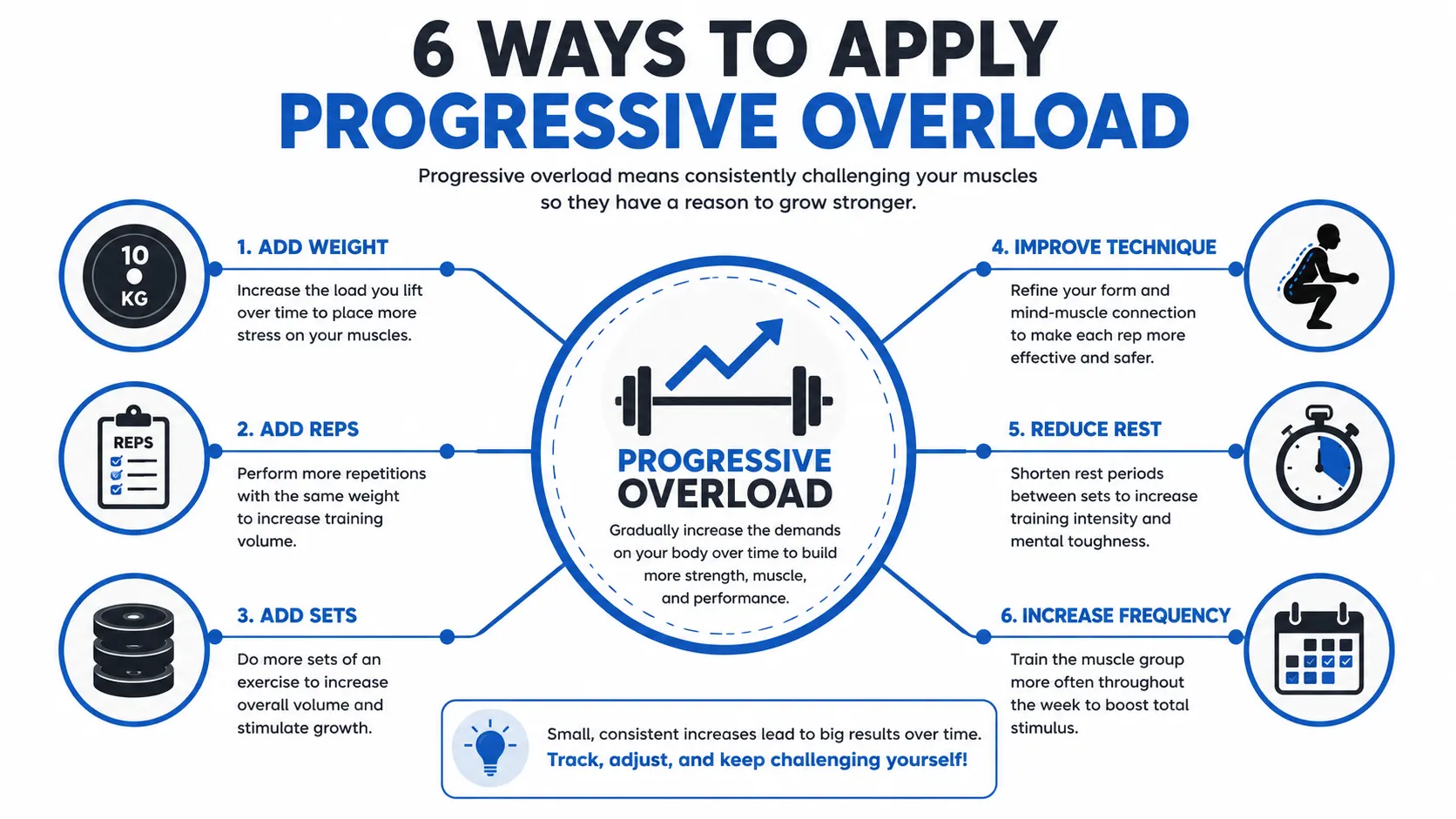
The six practical methods of progressive overload you can rotate across a training block.
In practice, most well-designed programs cycle through 2-3 of these methods across a training block rather than relying on one alone. For example: spend 6 weeks adding reps within a rep range (8→12), then reset to a slightly heavier weight for fewer reps (12→8) and repeat the climb. This is sometimes called a “double progression” model, and it’s one of the most sustainable approaches for intermediate lifters. See our complete double progression method guide for the exact week-by-week structure.
Progressive Overload Workout Plan Example
The fastest way to understand progressive overload in practice is to see it across a real training block. Here is a simple 4-week beginner bench press progression using the double progression method:
| Week | Target Sets x Reps | Load | Notes |
|---|---|---|---|
| Week 1 | 3 x 8 | 60 kg | Establish baseline, leave 2 reps in reserve |
| Week 2 | 3 x 9 | 60 kg | Add one rep per set |
| Week 3 | 3 x 10 | 60 kg | Top of rep range reached |
| Week 4 | 3 x 8 | 62.5 kg | Increase weight, reset reps, repeat |
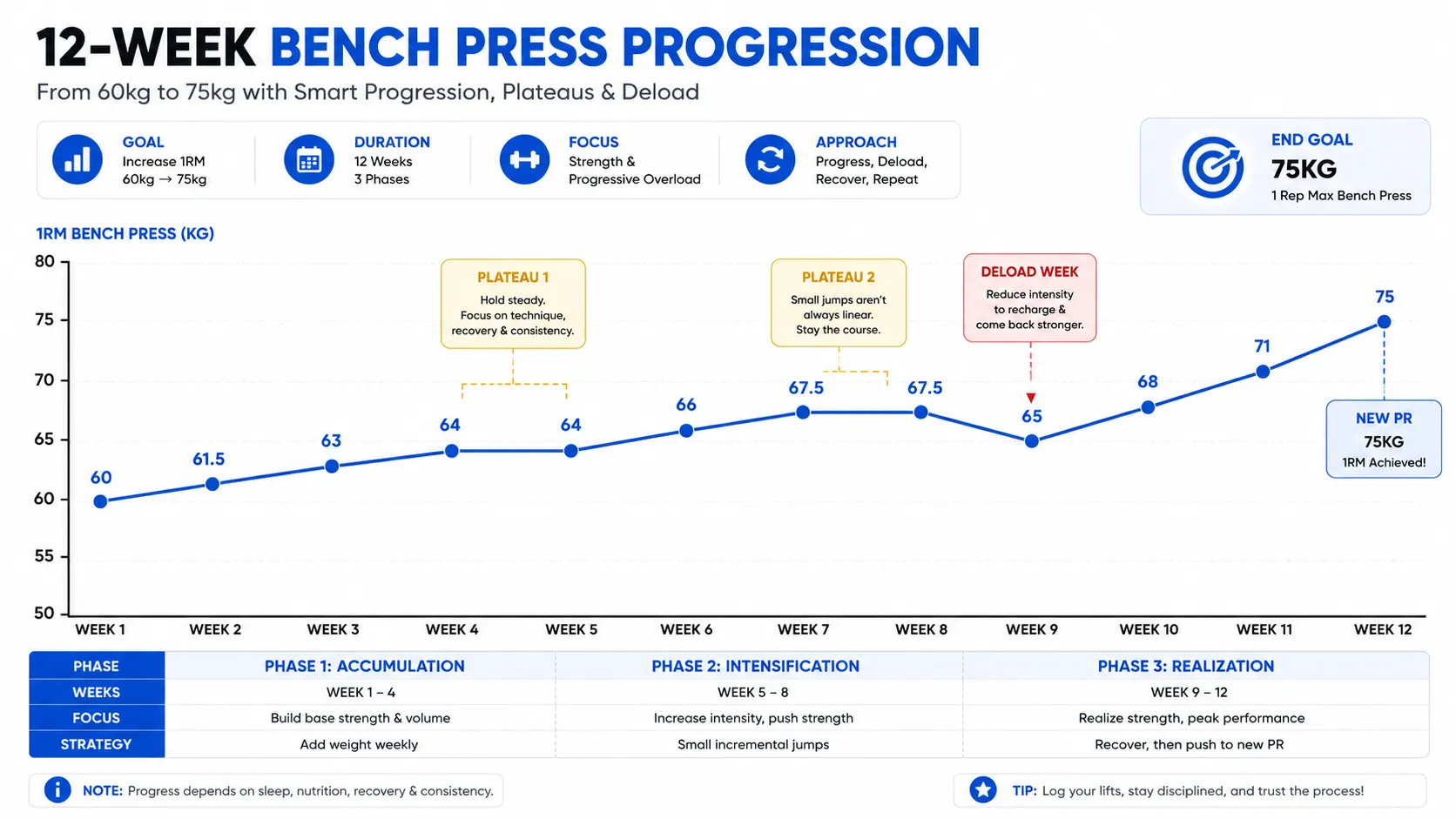
Progress is rarely linear every session, but the trend across weeks should move upward.
This is double progression, climb the rep range, then add load and climb again. It is one of the most sustainable models for intermediate lifters and can be applied to any compound or isolation lift. For the full framework see our double progression method guide.
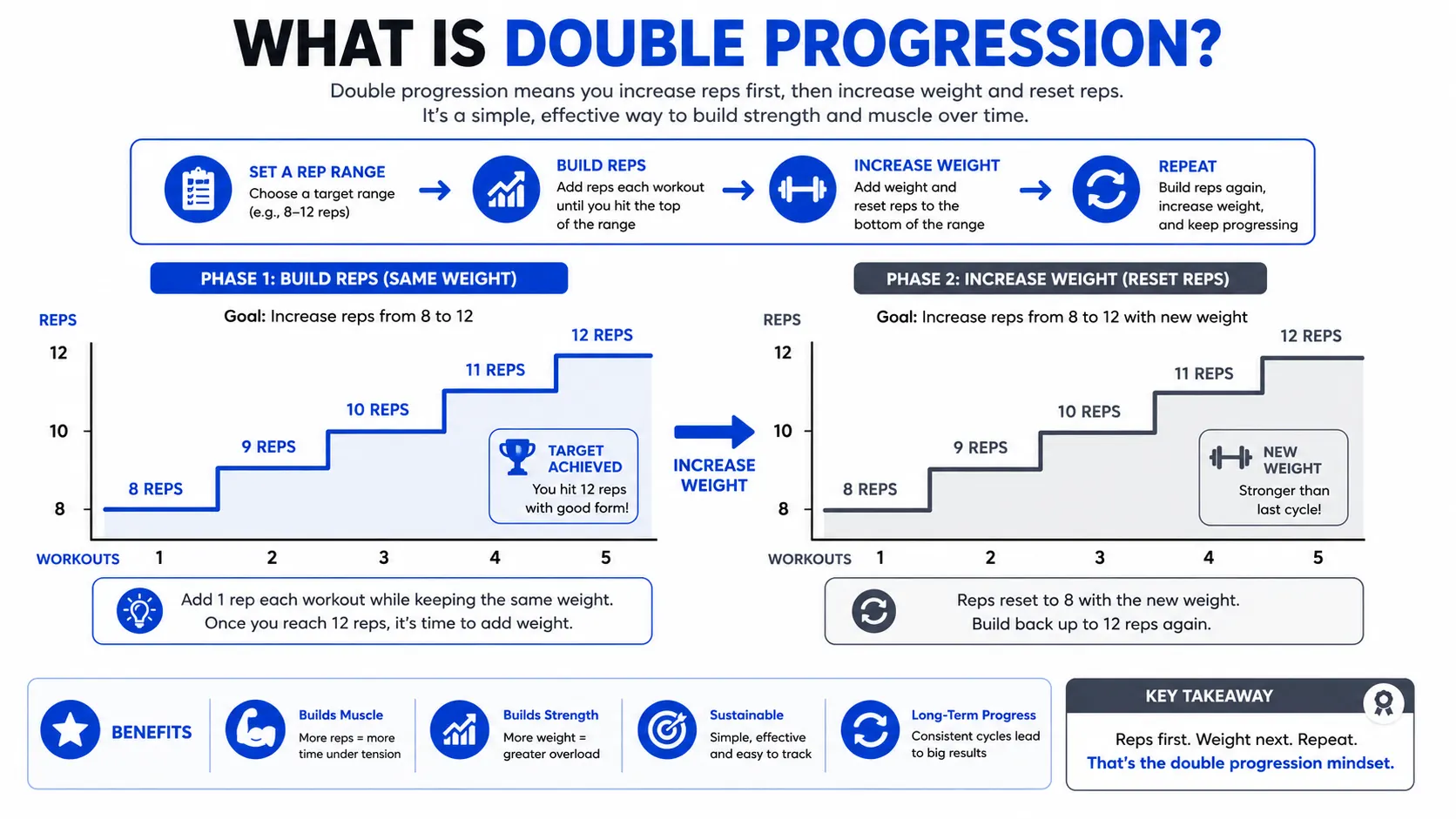
Double progression structure: climb reps first, then increase load and restart lower in the range.
For running or cardio, the same logic applies with different variables, add 5 to 10 minutes to your weekly duration, reduce rest intervals between intervals, or increase pace by a small increment each week.
Is Progressive Overload Safe?
Yes, when applied with appropriate increments and enough recovery. The risks are almost always from applying overload incorrectly rather than from the principle itself.
Common safety pitfalls to avoid:
- Jumping load too quickly. Adding 10 kg to a squat in one week is not progressive overload, it is a recipe for a form breakdown and possible injury. Small, consistent increments are far safer and more effective.
- Ignoring technique to lift heavier. If your range of motion shortens or your form degrades when you add weight, the overload is happening in the wrong place. The connective tissue, not the target muscle, absorbs most of it.
- Never deloading. Fatigue accumulates over weeks. Without a planned deload week every 4 to 8 weeks, overload eventually outpaces recovery and injuries follow. See our deload week guide.
- Progressing during high-stress periods. Sleep deprivation, illness, or unusually high life stress all reduce recovery capacity. Holding load steady or dropping volume temporarily is the right call, not a failure.
How to Structure Progressive Overload by Experience Level
Your training age changes how progressive overload should be applied. A beginner trying to use an advanced periodization model is often working against their own recovery capacity, and an advanced lifter using purely linear progression will plateau within weeks.
Beginners (0-1 year of consistent training)
Beginners have the most room to adapt, which means linear progression works well: add a small amount of weight or a rep almost every session on your main lifts. This can continue for weeks to months before it needs to change.
- Add 1.25-2.5kg to upper body lifts per session where possible.
- Add 2.5-5kg to lower body lifts per session where possible.
- When you fail to hit your target reps for two sessions in a row, hold the weight steady until you succeed, then continue.
Intermediate lifters (1-3 years)
Linear progression stops working reliably here, your recovery capacity hasn’t grown as fast as your strength has. Double progression (climb a rep range, then increase weight and drop back to the bottom of the range) or weekly undulating periodization (varying rep ranges across the week, e.g., heavy/moderate/light days) both work well.
Advanced lifters (3+ years)
At this stage, progress is measured in small increments over months, not sessions. Block periodization, dedicated phases for volume, then intensity, then peaking, combined with planned deloads becomes necessary to keep progressing without burning out. See our periodization for beginners guide for how linear, undulating, and block periodization models work, and our deload week guide for how to schedule recovery weeks.
Progressive Overload by Lift and Situation
Progressive overload works on every lift and in every training phase, but implementation changes based on context. Use these focused guides when you need specific instructions:
- Main lift guides: progressive overload squat, progressive overload bench press, progressive overload deadlift, and progressive overload overhead press
- Special scenarios: progressive overload in a calorie deficit, progressive overload for women, and progressive overload over 40
- Method-focused topics: progressive overload for bodyweight exercises, microloading for progressive overload, and when to increase weight
Progressive Overload for Cardio and Endurance
The same principle that drives muscle growth in the gym applies directly to running, cycling, swimming, and any other endurance activity.
- Runners apply progressive overload by adding weekly mileage gradually (the standard guideline is no more than 10% per week), increasing pace on interval sessions, or reducing recovery time between hard efforts.
- Cyclists can increase average power output, ride duration, or weekly elevation gain.
- General cardio users in the gym can reduce rest between cardio intervals, increase resistance or incline, or extend session duration by a small increment each week.
The mechanism is identical: a slightly greater demand than the body is currently adapted to, followed by adequate recovery, followed by repeating at a higher baseline.
Why Progressive Overload Stalls (Even When You’re Trying)
Progressive overload isn’t magic, it fails when one of the underlying requirements isn’t being met. The most common reasons:
- You’re not tracking your numbers. If you don’t know what you lifted last week, you can’t deliberately try to beat it. This is the single biggest reason lifters plateau without realizing it.
- You’re not recovering enough. Overload without adequate sleep, food, and rest just accumulates fatigue rather than adaptation.
- You’re already at your genetic/training ceiling for that rep range or exercise variation. This is when switching exercises, rep ranges, or taking a deload becomes useful.
- Your volume is too low or too high. Too little volume under-stimulates the muscle; too much creates fatigue that masks your actual strength. See our guide on workout volume to find your range.
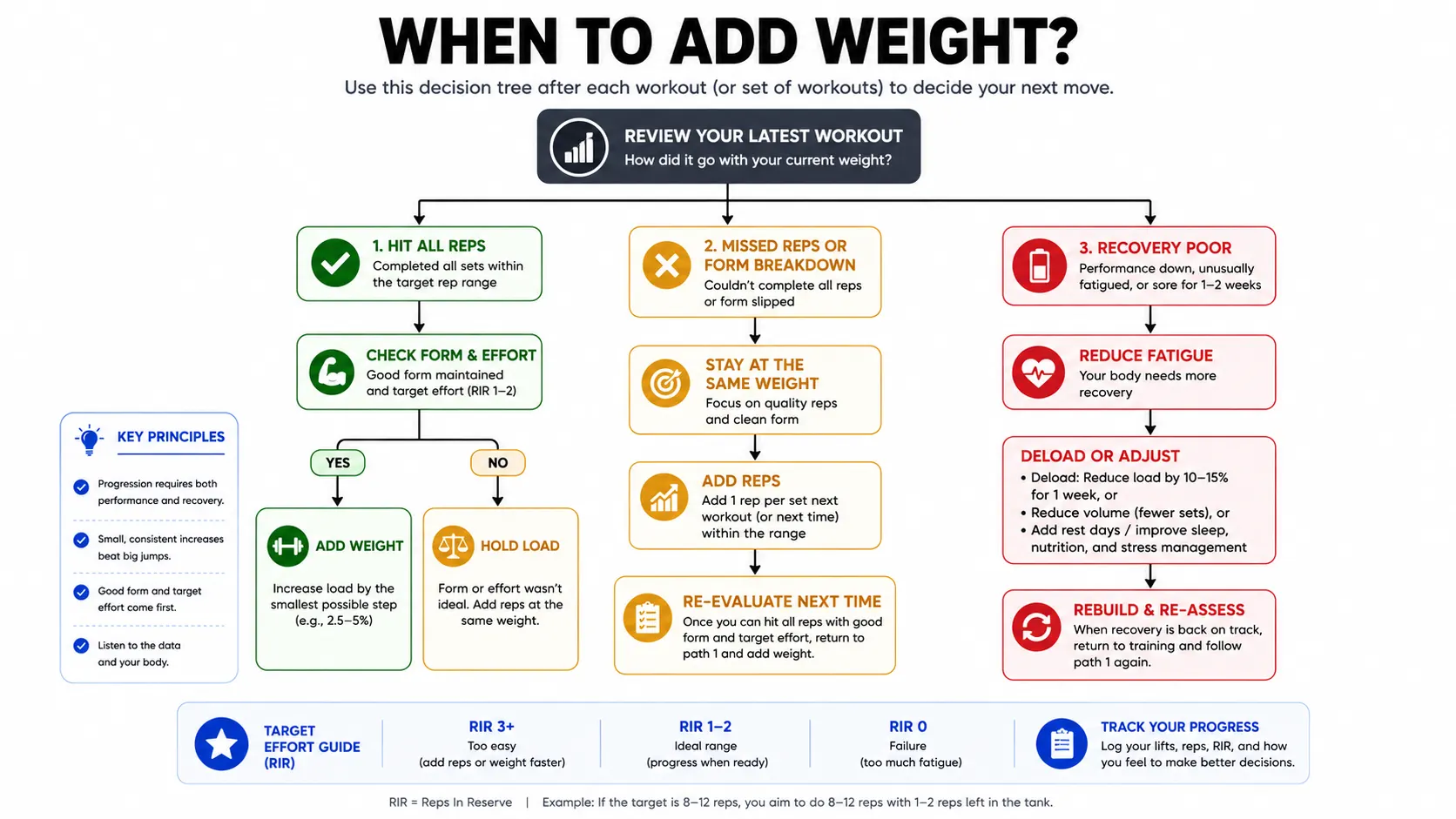
Use objective rules to decide your next progression step instead of guessing session to session.
Common Mistakes
- Chasing weight increases every single session, forever. This works for a few months as a beginner, then becomes a recipe for stalled lifts and nagging joint pain. Progress should be measured across a training block, not every workout.
- Ignoring reps and range of motion to hit a heavier number. A “heavier” squat with half the depth isn’t actually progressive overload, it’s a different, easier exercise.
- Never deloading. Continuously pushing overload without planned recovery weeks leads to accumulated fatigue that eventually forces an unplanned break (or injury).
- Overloading every exercise in every session. This spreads your recovery capacity too thin. Prioritize overload on your main lifts; let accessories progress more gradually.
- Not having a plan at all. “Try to lift a bit more than last time” is a strategy, but it’s a weak one without structure. A written progression scheme (even a simple one) outperforms improvisation.
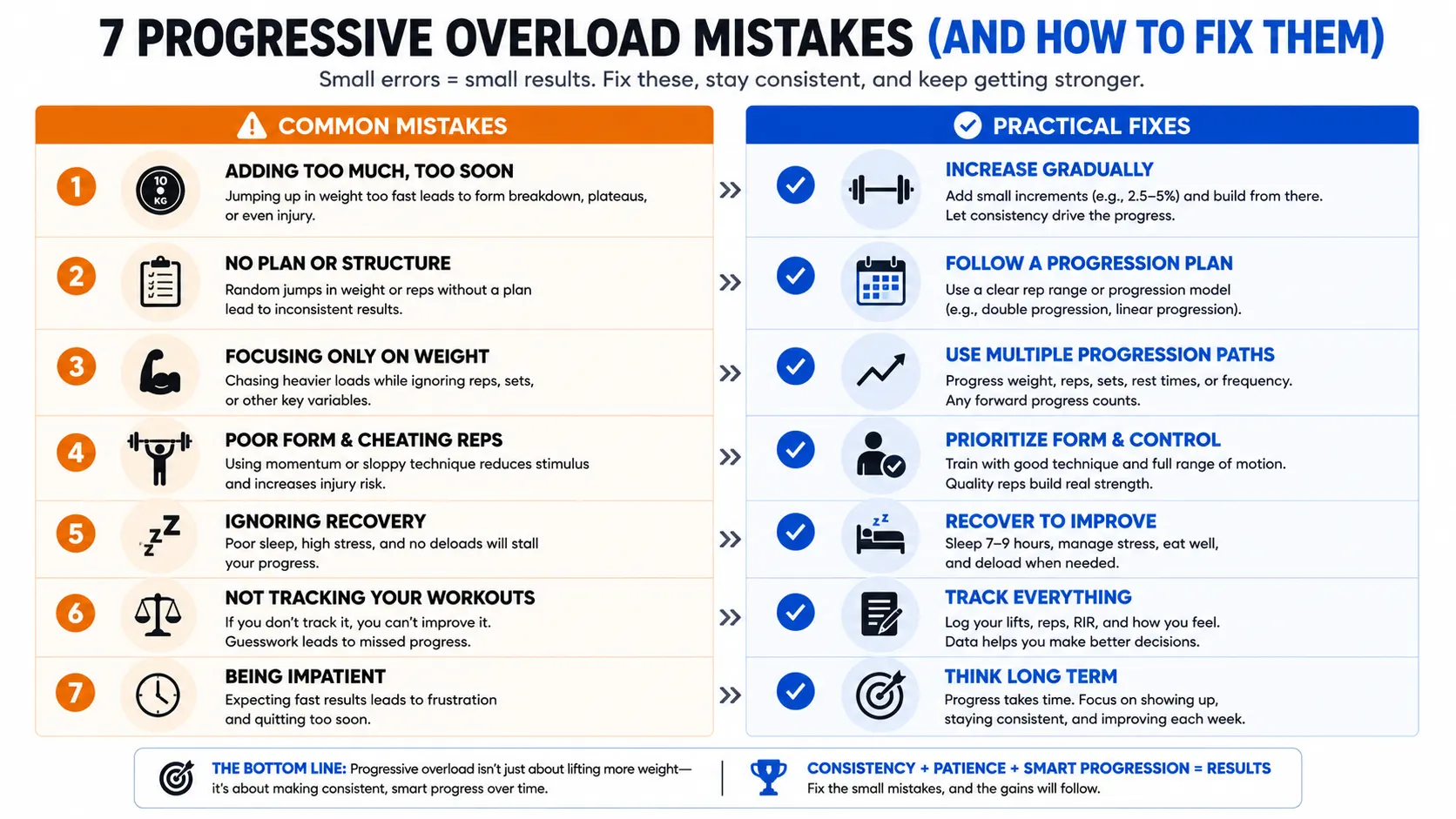
Most plateaus come from process errors, not effort problems.
See our full 7 progressive overload mistakes guide for a deeper breakdown of each one and exactly how to fix it.
Practical Tips
- Pick 2-4 main lifts per training block to prioritize overload on. Don’t try to progress everything at once.
- Write your target weight/reps down before you walk into the gym, based on what you did last time. Decide your progression in advance, not mid-set.
- If a lift stalls for 3 sessions in a row, don’t just keep repeating the same failed attempt, change rep range, add a deload, or address a weak point with accessory work.
- Track total volume (sets × reps × weight) per muscle group weekly, not just individual lift numbers, this often reveals overload opportunities you’re missing.
- Re-test your progression plan every 6-8 weeks. What worked as a beginner method may need to shift to double progression or periodization as you advance.
Calculator Integration
Once you understand the six overload methods, the next question is how much to add and when. This is exactly what the Progressive Overload Calculator is built for, enter your current lift, reps, and training experience, and it builds a week-by-week plan using the add-weight, add-reps, or add-sets method, tailored to your level. It’s the fastest way to turn the theory in this guide into an actual number you can walk into the gym with next session.
If you also want to know how a lift compares to your estimated max (useful for setting percentage-based progression targets), pair it with the One Rep Max Calculator.
Summary
- Progressive overload is the gradual increase in training demand that forces your body to keep adapting, it’s the foundation of long-term muscle and strength gains.
- There are six real methods: adding weight, reps, sets, improving technique/ROM, reducing rest, or increasing frequency.
- Beginners can often use simple linear progression; intermediates need double progression or undulating periodization; advanced lifters need structured blocks with planned deloads.
- Progress should be measured across a training block (weeks to months), not forced into every single session.
- Most stalled progress comes down to poor tracking, inadequate recovery, or volume that’s too low or too high.
- Prioritize overload on your main compound lifts rather than trying to progress everything simultaneously.
- Tracking your numbers is what makes deliberate overload possible in the first place.