Incline Bench Press vs Flat Bench Press: Which Builds a Better Chest?

Chest day debates rarely get more heated than incline vs flat bench press. Both hit the pectoralis major, but the angle changes which part of the chest does the most work and how much shoulder gets involved.

Which Is Better?

Flat bench press builds slightly more overall chest mass and allows heavier loads, while incline bench press emphasizes the upper chest (clavicular head) more directly and involves the shoulders more. Neither replaces the other — most complete chest programs include both.

Exercise Overview

The incline bench press is performed on a bench set at roughly a 30-45 degree angle, pressing the bar from the upper chest to full arm extension. It shifts more emphasis onto the upper (clavicular) pectoralis fibers and the anterior deltoid.

The flat bench press is performed on a horizontal bench and is the standard version most people mean when they say “bench press.” It trains the chest overall and allows the heaviest loading of any pressing variation.

Both full guides cover complete step-by-step technique — this page focuses on choosing between (or combining) the two.
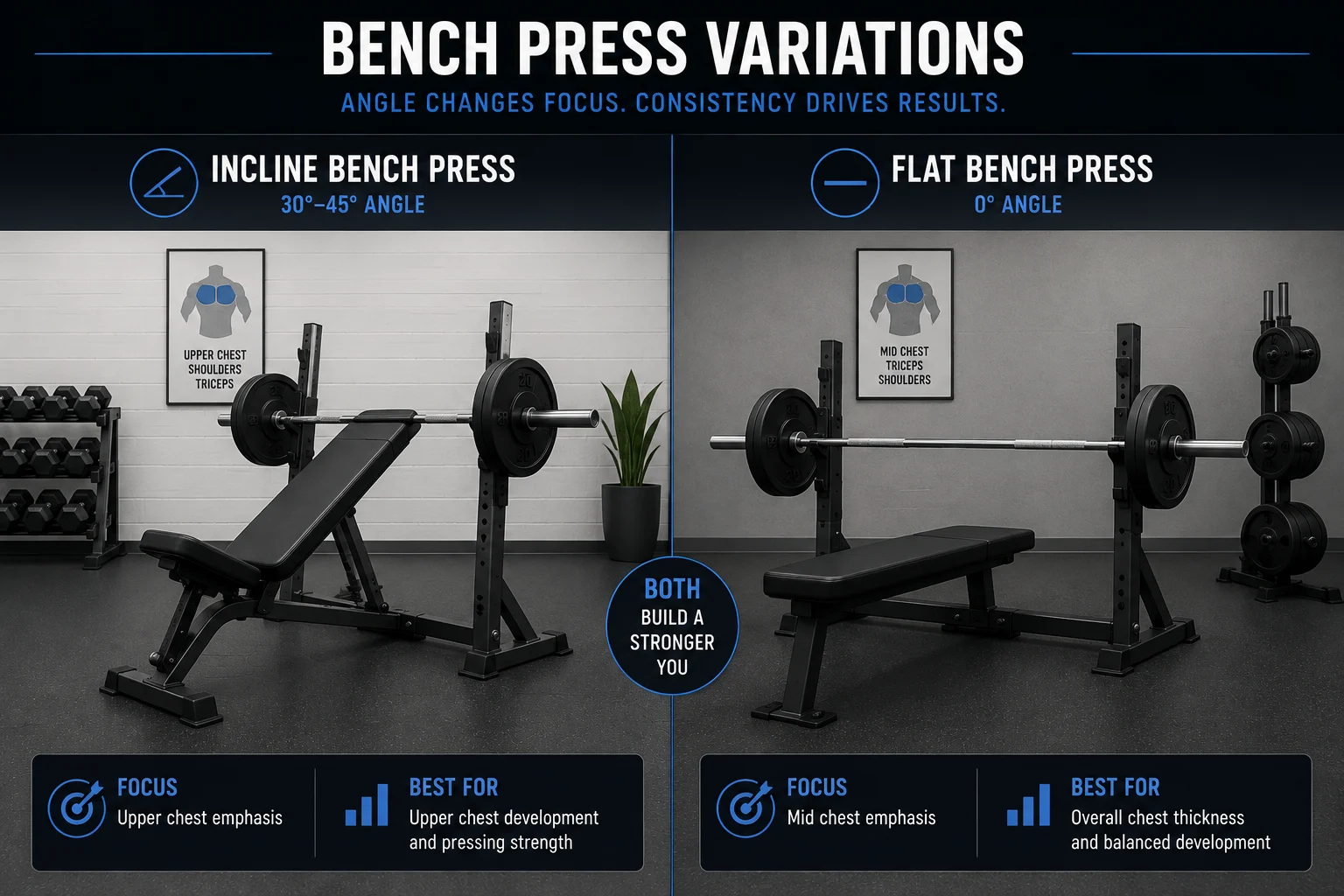
Incline bench press vs flat bench press side-by-side angle comparison

Muscles Worked

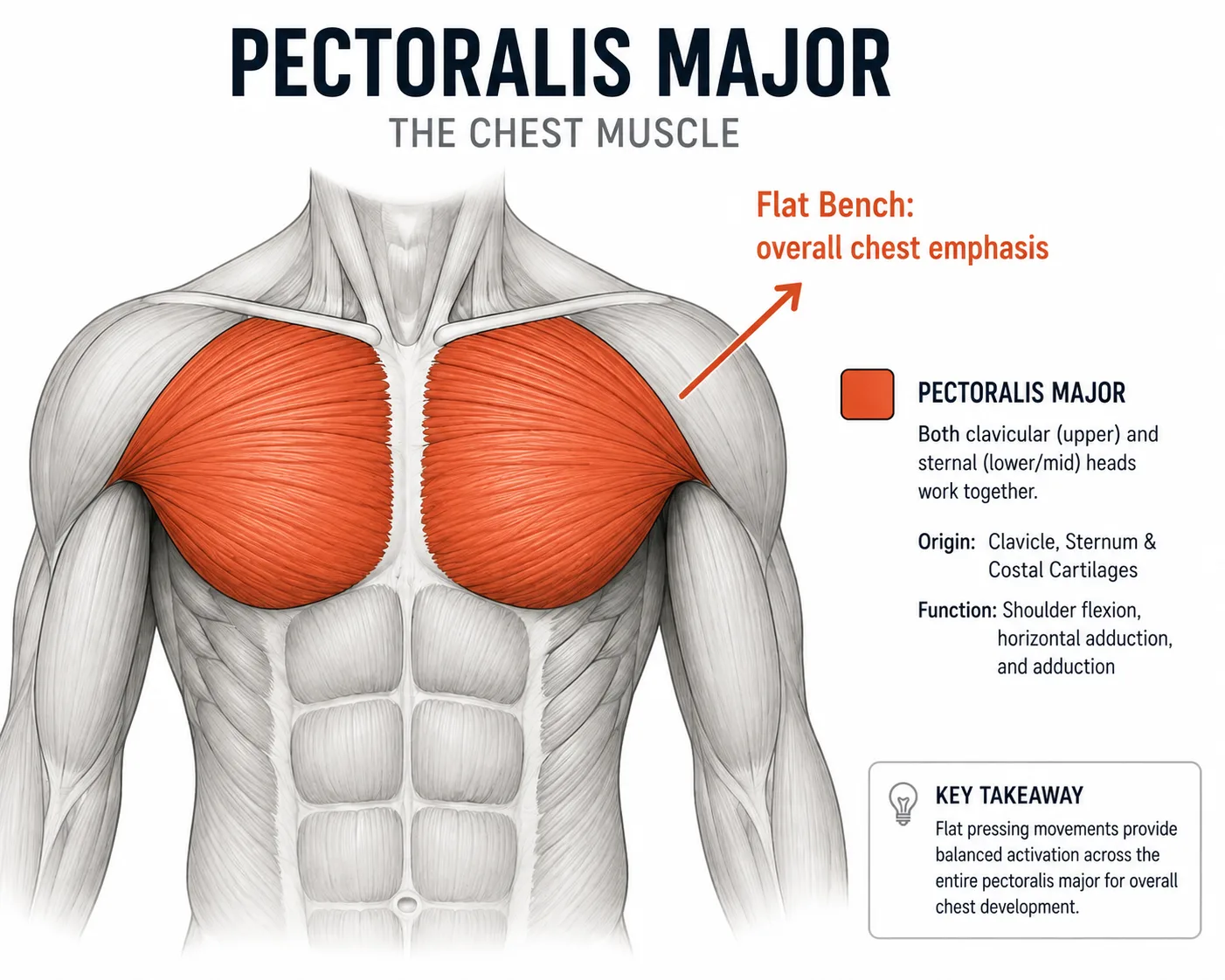
Both variations train the pectoralis major, triceps, and anterior deltoid. The key difference is emphasis: incline bench press shifts more work onto the upper chest fibers and front delts due to the angle of the press, while flat bench press distributes the work more evenly across the mid and lower chest.

Neither variation isolates the upper or lower chest completely — the pectoralis major functions as one muscle — but the angle meaningfully changes which fibers do proportionally more work.
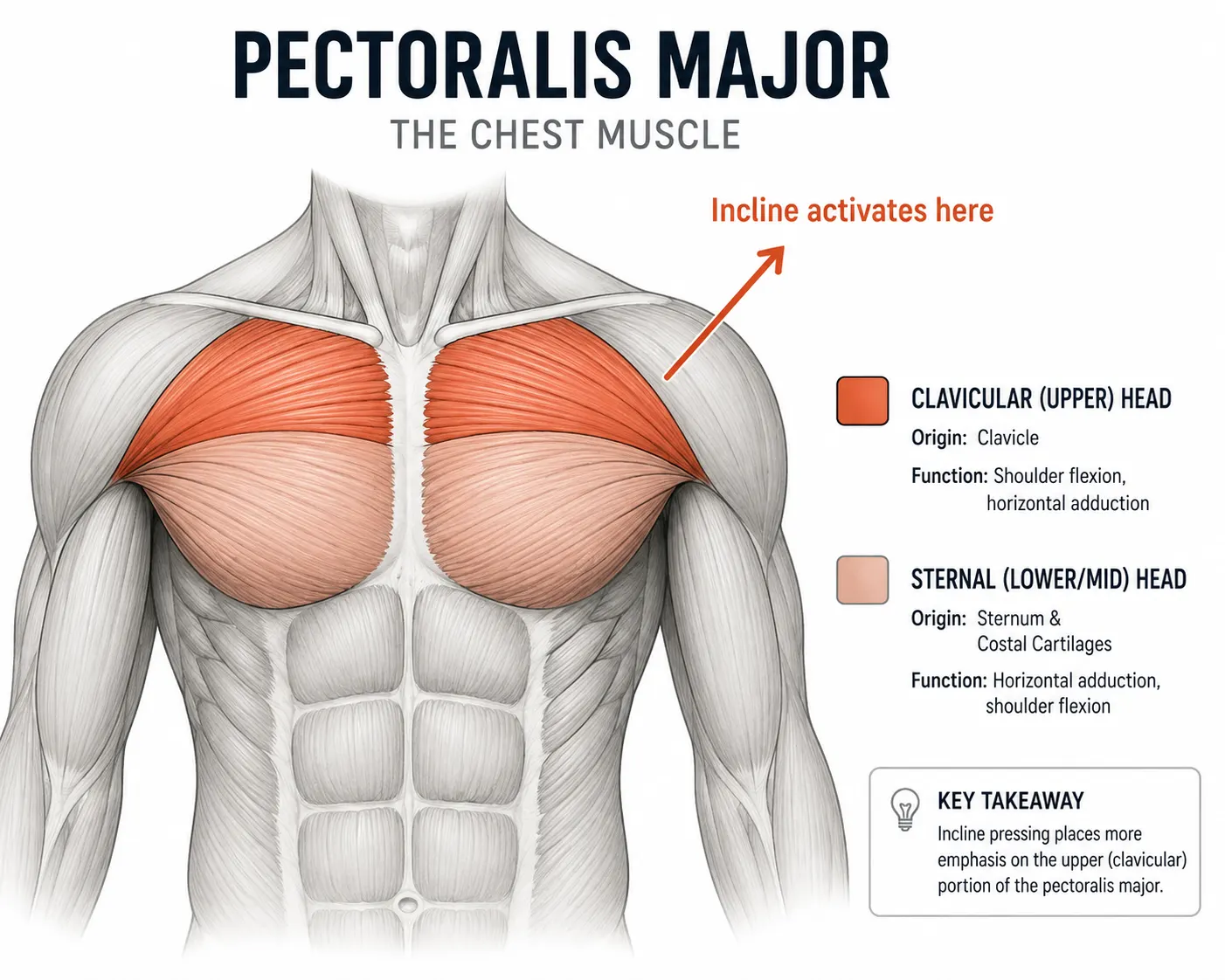
Upper chest muscle activation diagram for incline bench press vs flat bench press overall chest activation

Flat bench press overall chest activation diagram showing full pectoralis major emphasis

Strength Development

Flat bench press allows the heaviest total loads and remains the standard reference for pressing strength — it’s also the competition lift in powerlifting. Incline bench press typically allows 10-20% less weight at a given effort level because more of the load shifts to the smaller anterior deltoid.

Both build genuine pressing strength, but if your goal is a single number to track maximal strength, flat bench press is the more standard benchmark.

Why Is Incline Bench Harder Than Flat?

Incline bench press is harder than flat bench press for most lifters because the inclined angle reduces the mechanical advantage of the chest and places a greater share of the load on the anterior deltoid, which is a smaller and weaker muscle. You’re essentially asking a smaller muscle group to do more of the work, which is why flat bench feels easier and allows heavier loads at the same level of effort.

The degree of difficulty increases as the incline angle gets steeper. At 45 degrees or above, the press starts to resemble a shoulder press more than a chest press, shifting emphasis further away from the pectorals. Keeping the bench at 30-45 degrees keeps the movement chest-dominant while still targeting the upper fibers.
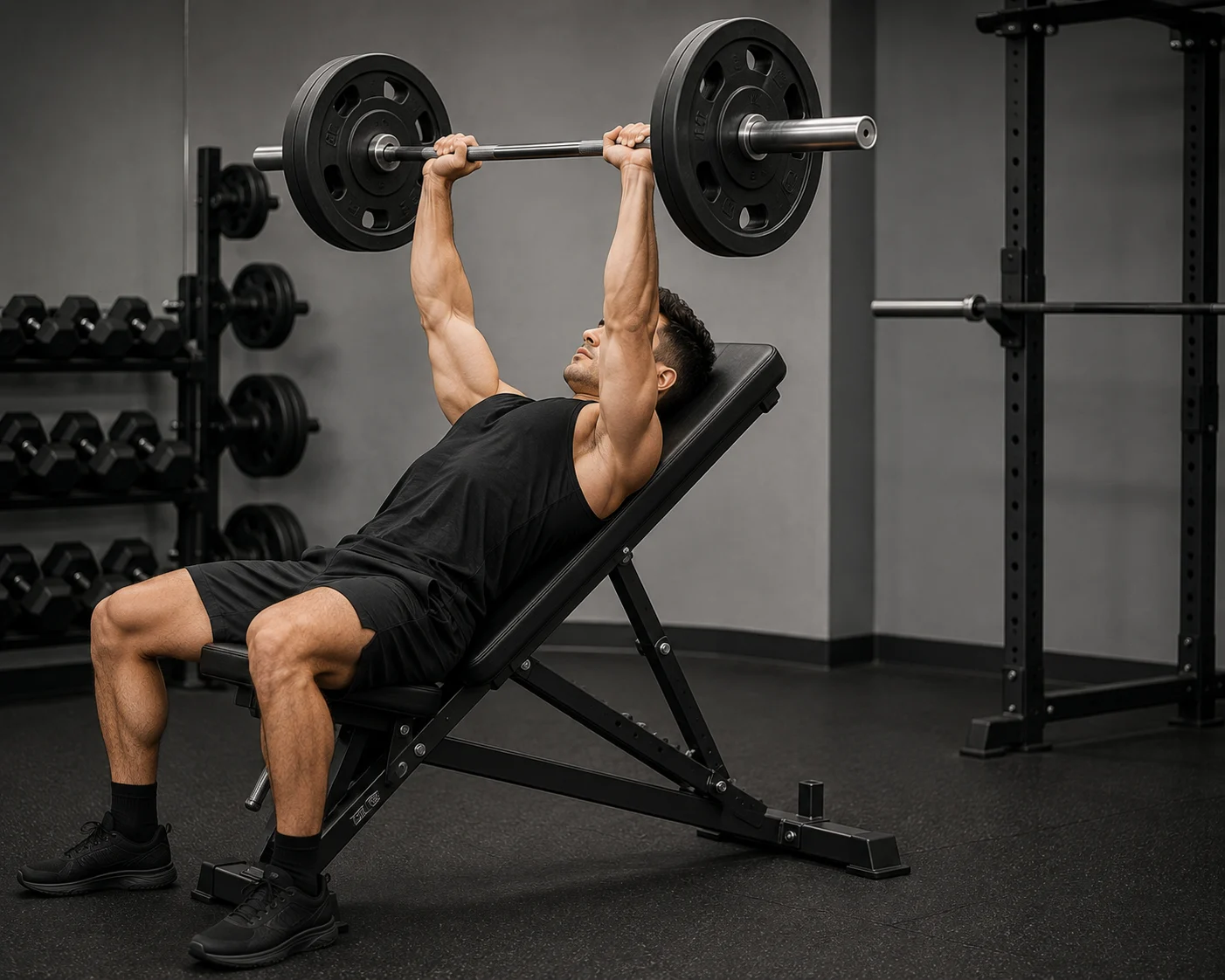
Proper incline bench press form showing correct bar path and elbow angle

Muscle Growth

For overall chest mass, flat bench press has a slight edge due to the heavier loads typically used. For upper chest development specifically — often the last area to develop and the most visually noticeable from the front — incline bench press is more effective.

Since the pectoralis major has both upper and lower/mid fiber regions that respond somewhat differently to different pressing angles, a program that includes both movements builds more complete chest development than either alone.

Beginner Friendliness

Flat bench press is usually the more intuitive starting point since it’s the more commonly taught variation and the bar path is slightly more stable. Incline bench press requires a bit more shoulder stability and a properly set bench angle, but is still very learnable for beginners within a few sessions.

Safety

Both variations carry similar overall risk profiles — always use a spotter or safety pins for near-maximal sets on either. Incline bench press places somewhat more stress on the anterior shoulder, especially at steep angles above 45 degrees, so lifters with existing shoulder discomfort may find flat bench press more comfortable.

Programming

A well-rounded chest program includes both: flat bench press as the primary strength movement (3-10 reps) and incline bench press as a secondary movement for upper chest development (6-12 reps). Training each once or twice weekly is a reasonable starting point for most intermediate lifters.

They pair well in the same session (one heavy, one moderate) or on separate training days in a push/pull/legs or upper/lower split.
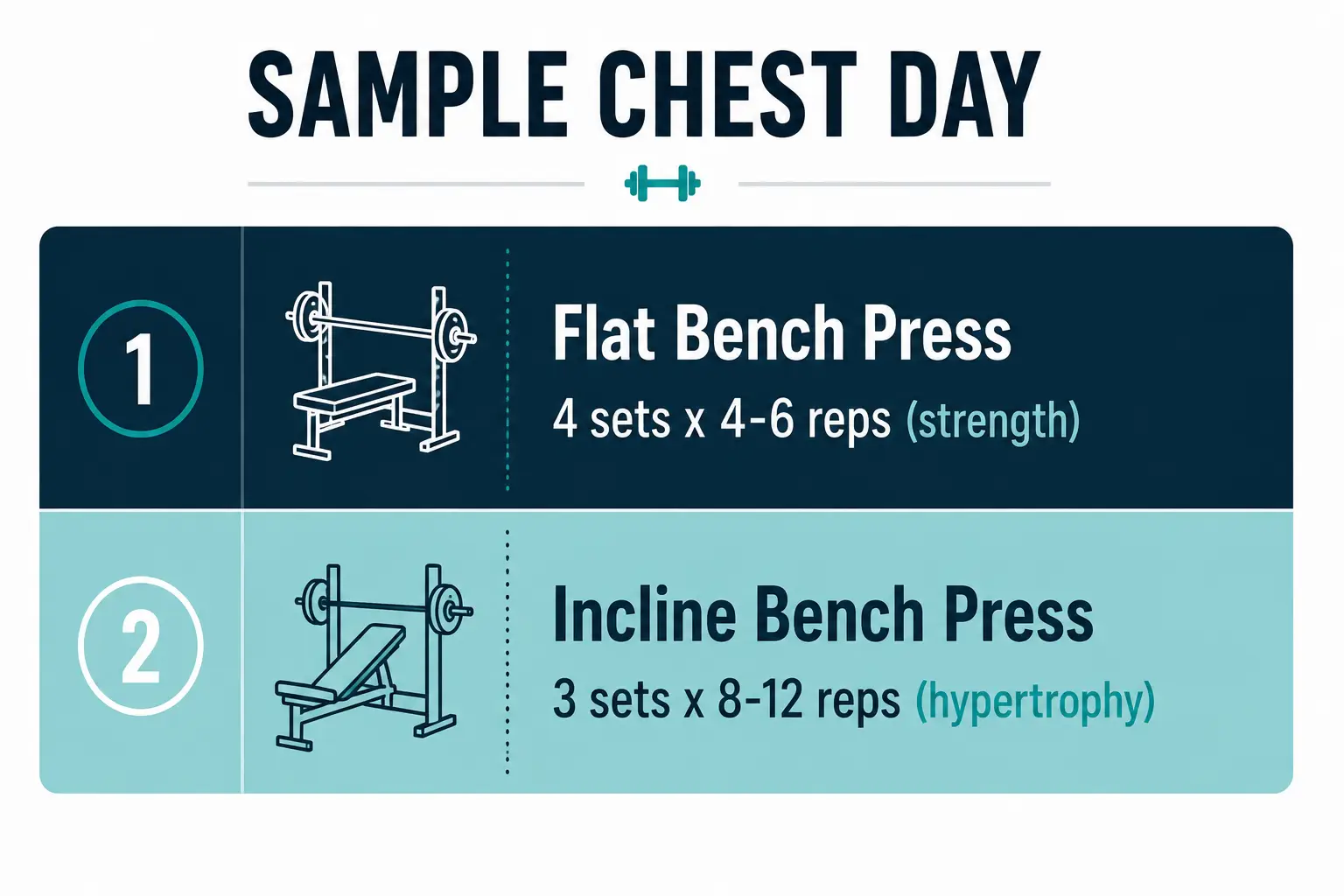
Sample weekly chest programming combining flat bench press and incline bench press sets and reps

Common Mistakes

Incline bench press mistakes: setting the bench too steep (turning it into a shoulder press), and using too little weight to compensate for the harder leverage. Fix these by keeping the angle around 30-45 degrees and choosing weight based on incline-specific strength, not flat bench numbers.

Flat bench press mistakes: relying on it exclusively and neglecting upper chest work entirely, which can leave the chest looking underdeveloped up top. Fix this by adding incline pressing into your weekly program even if flat bench press remains your primary strength lift.


Frequently Asked Questions

Does incline bench press really target the upper chest more?

Yes. Electromyography studies consistently show greater upper (clavicular) pectoralis activation on incline presses compared to flat bench press, especially at incline angles around 30-45 degrees.

Should I do incline or flat bench press first in my workout?

Train whichever area is a priority or weak point first, since you have the most energy and strength at the start of a session. Many lifters alternate which one goes first each week.

Can incline bench press replace flat bench press entirely?

It can if your priority is purely upper chest shape, but most programs benefit from including both since flat bench trains overall chest mass and allows heavier loading.

What incline angle is best for upper chest growth?

Around 30-45 degrees is the most commonly recommended range. Very steep inclines (60 degrees or more) start to shift emphasis toward the shoulders rather than the chest.

Why is my incline bench press so much weaker than my flat bench press?

This is completely normal. The incline angle changes the mechanical leverage and shifts more work onto the anterior deltoid, so most lifters can move noticeably less weight on incline than flat bench.

Is incline bench press harder on the shoulders?

It can be at steep angles, since the anterior deltoid takes on more of the load. Keeping the incline moderate (30-45 degrees) and avoiding flared elbows helps manage shoulder stress.

How many sets of incline vs flat bench press should I do per week?

A common approach is 2-4 sets of flat bench and 2-4 sets of incline bench press per week, adjusted based on whether upper chest is a priority area for you.

Does flat bench press train the whole chest evenly?

Flat bench press primarily emphasizes the mid and lower chest fibers, with less direct upper chest involvement than incline pressing, which is why many programs pair the two.

Can beginners start with incline bench press instead of flat?

Yes, though most beginners find flat bench press slightly more intuitive since it's the more common variation. Either is a reasonable starting point with proper coaching.

Is incline bench harder than flat bench press?

Yes, for most lifters incline bench press is harder than flat bench press at an equivalent weight. The inclined angle reduces the chest's mechanical advantage and demands more from the anterior deltoid, which is smaller and fatigues faster. This is why flat bench feels easier and allows heavier loads — it's not a technique issue, it's basic geometry. Keeping the incline between 30 and 45 degrees minimises the difficulty gap while still targeting the upper chest effectively.

Does incline bench press help increase your flat bench press?

Yes, indirectly. Incline bench press strengthens the upper chest and anterior deltoid, both of which contribute to the flat bench press. Lifters who add consistent incline work often find their flat bench press lockout and overall pressing strength improve over time. It's a common accessory movement even for powerlifters whose competition lift is the flat bench press.

Is incline bench and flat bench press enough for chest?

For most lifters, yes. Combining flat bench press and incline bench press covers the mid, lower, and upper chest fibers across two compound pressing movements with good overlap. Adding cable flyes or dumbbell variations on top can increase the stretch stimulus and add volume, but the two bench press variations together form a solid foundation for complete chest development without needing a long list of isolation exercises.

What is the difference between chest press and incline press?

'Chest press' typically refers to any horizontal pressing movement — most commonly the flat bench press or a machine chest press performed at a flat angle. Incline press specifically refers to a press performed with the bench angled upward (usually 30-45 degrees), which shifts emphasis to the upper chest and front deltoid. Both target the pectoralis major, but the flat chest press hits the overall chest with heavier loads while the incline press targets the upper chest fibers more directly.

Is dumbbell incline press better than barbell incline press?

Both are effective. Dumbbells allow a deeper stretch and independent arm movement, while the barbell allows heavier total loading — similar to the general bench press vs dumbbell bench press comparison.

How much less weight should I expect to lift on incline vs flat bench press?

Many lifters use roughly 80-90% of their flat bench weight on incline bench press, though this varies by individual shoulder mechanics and incline angle.

Does incline bench press build a bigger chest overall?

Not on its own — it builds the upper chest specifically. For overall chest size, flat bench press or a combination of both typically produces more complete development.

What's a good incline bench press rep range for hypertrophy?

Most lifters see good upper chest growth training incline bench press in the 6-12 rep range, similar to general hypertrophy guidelines for compound pressing movements.

Should powerlifters train incline bench press?

Yes, as an accessory. While flat bench press is the competition lift, incline bench press strengthens the upper chest and shoulders, which supports the flat bench press lockout and overall pressing strength.

Can I do both incline and flat bench press in the same workout?

Yes, this is a common and effective approach — train one heavy for strength and the other for volume and shape within the same session or across the week.

Raaj, author of SleetGymTracker blog

Raaj

Hi, I am Raaj, the author of this blog. I have been into fitness for 7 years and have trained over 40 people in-person, mostly complete beginners. I started lifting at 17 with zero idea what I was doing and spent years figuring out what actually works. Everything I write comes from that experience. I built SleetGymTracker because I wanted a tracker that takes progressive overload seriously, and a blog that gives straight answers without the fluff. If something is unclear or you want to reach out, contact me at raaj@sleetgymtracker.com

Track Whichever One You Choose With Sleet

Whether you go with Incline Bench Press or Flat Bench Press, Sleet logs every set, rep, and weight automatically, so you always know exactly when to add weight next — no spreadsheet required.

Get it on Google Play