Introduction
The incline bench press is the standard way to specifically target the upper chest, complementing the flat bench press by shifting more emphasis onto the clavicular head of the pectoralis major.
The incline bench press is also called the incline barbell press or inclined bench press in many programs. All three terms describe the same movement pattern.
Who should perform it: almost anyone training for chest hypertrophy or general upper-body pressing strength, provided they don’t have a specific shoulder injury a physiotherapist has flagged against pressing.
When it should be used: as part of a chest-focused training day, either as a primary pressing movement or paired with a flat or decline press for complete chest development.
Best Incline Bench Press Angle and Degree
For most people, the best incline bench press angle is 30 degrees.
This angle usually gives the best trade-off between upper chest stimulus and shoulder comfort. If the bench is too steep, the movement starts behaving more like an overhead press and less like a chest press.
| Bench Angle | What You Will Usually Feel | Best Use Case |
|---|---|---|
| 15-20 degrees | More chest, less front-delt stress | Lifters with sensitive shoulders, low-incline chest focus |
| 30 degrees | Strong upper chest focus with good loading potential | Default choice for most lifters |
| 45 degrees | More front-delt involvement, less chest bias | Variation blocks, shoulder-focused pressing days |
Practical rule: start at 30 degrees, run it for 4 to 6 weeks, and only adjust if shoulder comfort or upper chest stimulus is poor.
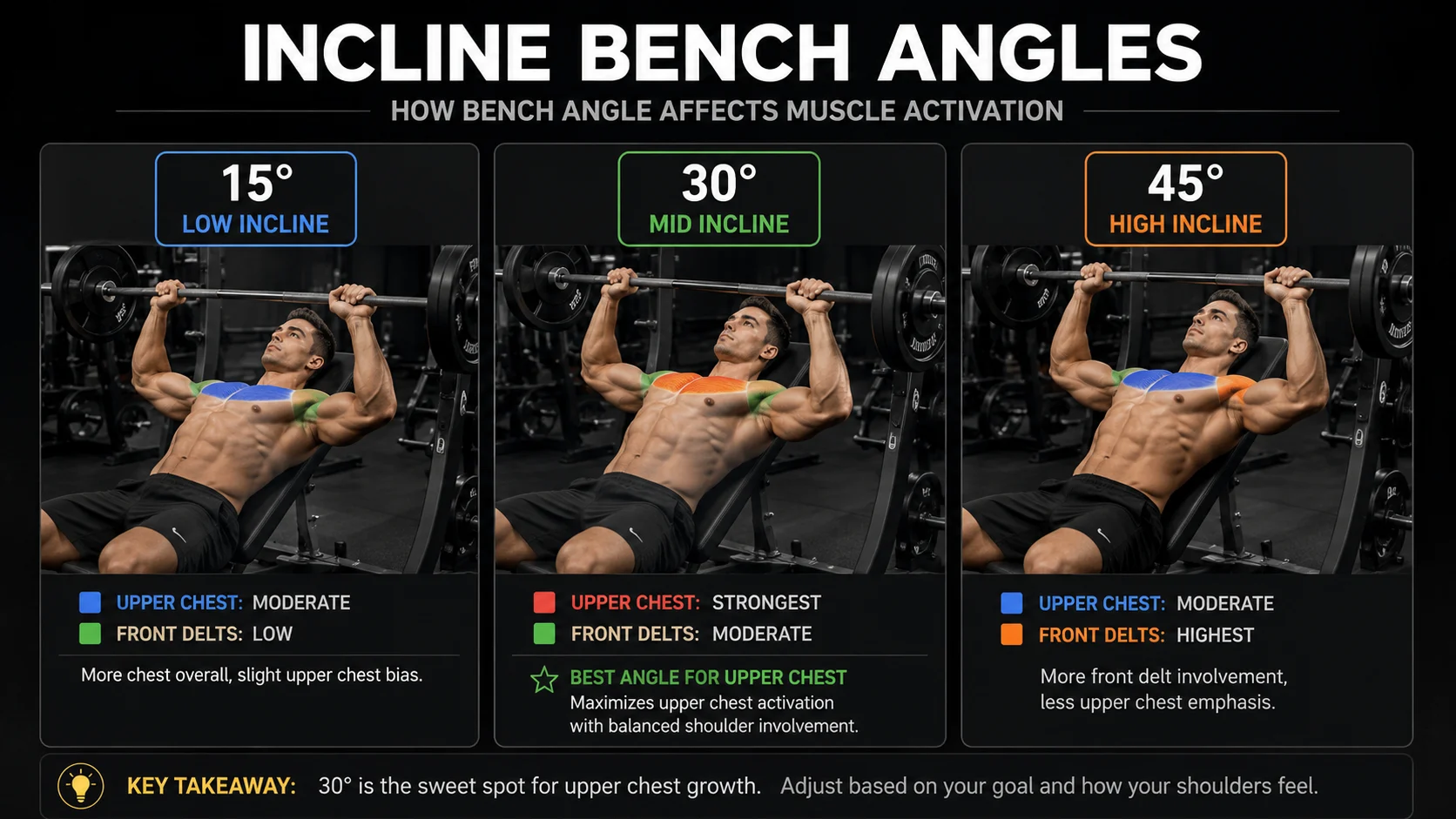 Best incline bench press degree: 30 degrees is the recommended starting point for most lifters.
What Muscles Does Incline Bench Press Work?
| Role | Muscle | Why It Contributes |
|---|---|---|
| Primary | Upper (Clavicular) Pectoralis Major | The incline angle shifts more of the pressing demand onto this upper chest region compared to a flat bench press. |
| Secondary | Anterior Deltoid | Assists shoulder flexion, contributing more here than in a flat bench press due to the incline angle. |
| Secondary | Triceps Brachii | Extends the elbow, driving the second half of the press. |
| Stabilizer | Rotator Cuff Muscles | Stabilize the shoulder joint throughout the pressing motion. |
| Stabilizer | Core | Helps maintain a stable torso position on the angled bench. |
EMG research comparing bench angles generally shows increasing upper chest activation as the incline angle increases up to a point, with anterior deltoid involvement also rising alongside it.
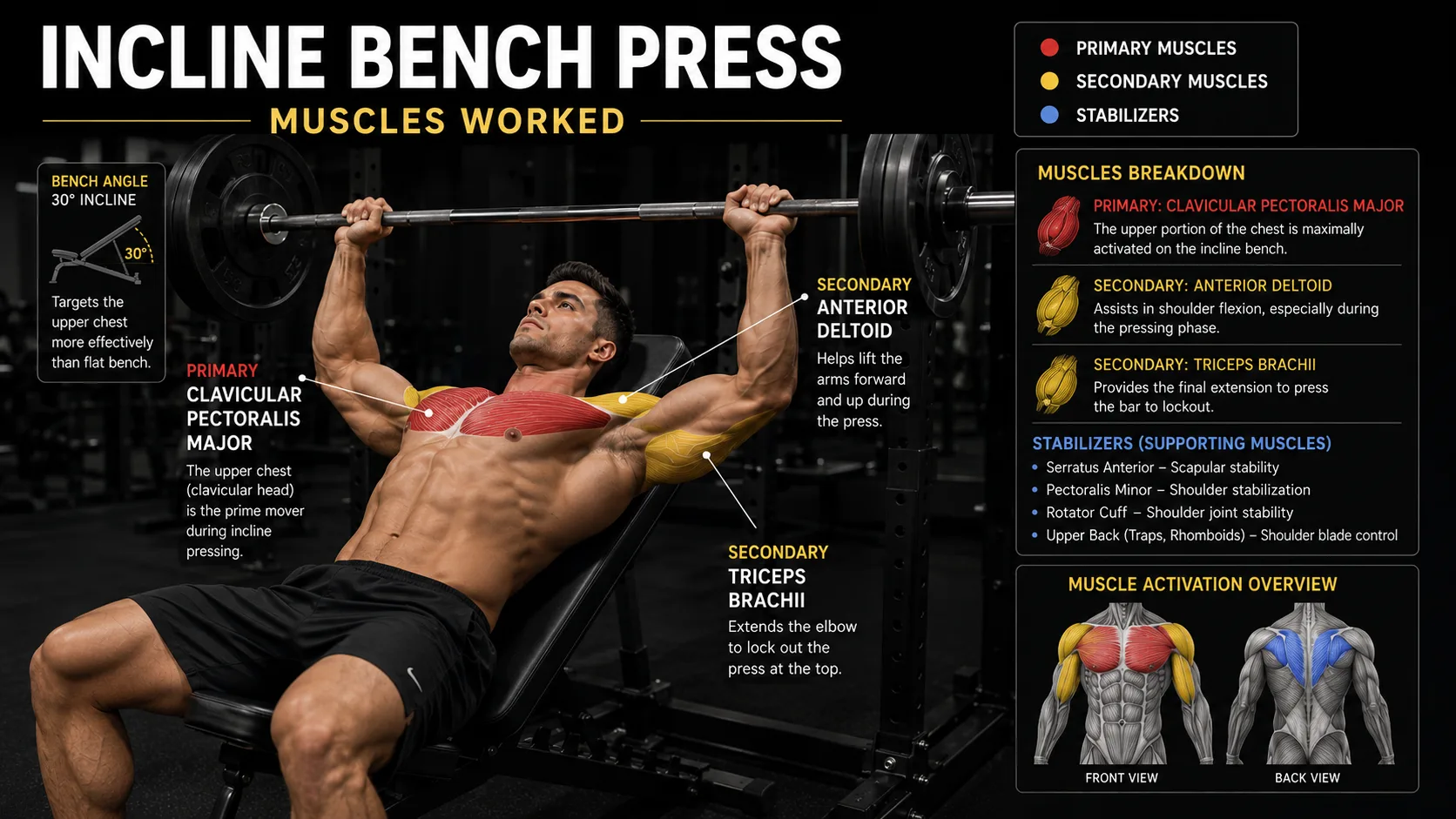 Incline chest press muscles worked: upper chest is the primary mover, with front delts and triceps assisting.
Incline Bench Press Benefits
Targets the upper chest specifically. The incline angle changes the joint mechanics of the press in a way that increases relative demand on the clavicular (upper) pectoral fibers compared to a flat bench press.
Completes overall chest development. Pairing incline pressing with flat or decline pressing addresses both major chest fiber regions, since research suggests they don’t respond identically to a single angle.
Progressive overload friendly. Like the flat bench press, the barbell or dumbbell setup makes it straightforward to add small, precise increments over time.
Can be more shoulder-friendly for some lifters. Some lifters find a moderate incline angle more comfortable on the shoulder joint than a flat bench press, though this varies individually.
If you are asking what incline bench press is good for, the short answer is upper chest size, balanced chest development when paired with flat pressing, and improved control in angled pressing patterns.
How to Perform the Incline Bench Press
-
Set the bench to a 15-45 degree incline, with 30 degrees being a common, effective starting point that balances upper chest emphasis with shoulder involvement.
-
Lie back so your eyes are roughly under the bar, feet flat on the floor for a stable base.
-
Grip the bar slightly wider than shoulder width, or hold dumbbells at chest level with palms facing forward.
-
Pull your shoulder blades down and together and hold this position throughout the lift, just as with the flat bench press.
-
Lower the weight to your upper chest, keeping elbows at roughly a 45-75 degree angle from your torso.
-
Press the weight back up and slightly back toward the starting position over your shoulders, exhaling as you press.
-
Lock out your arms fully at the top without shrugging your shoulders forward.
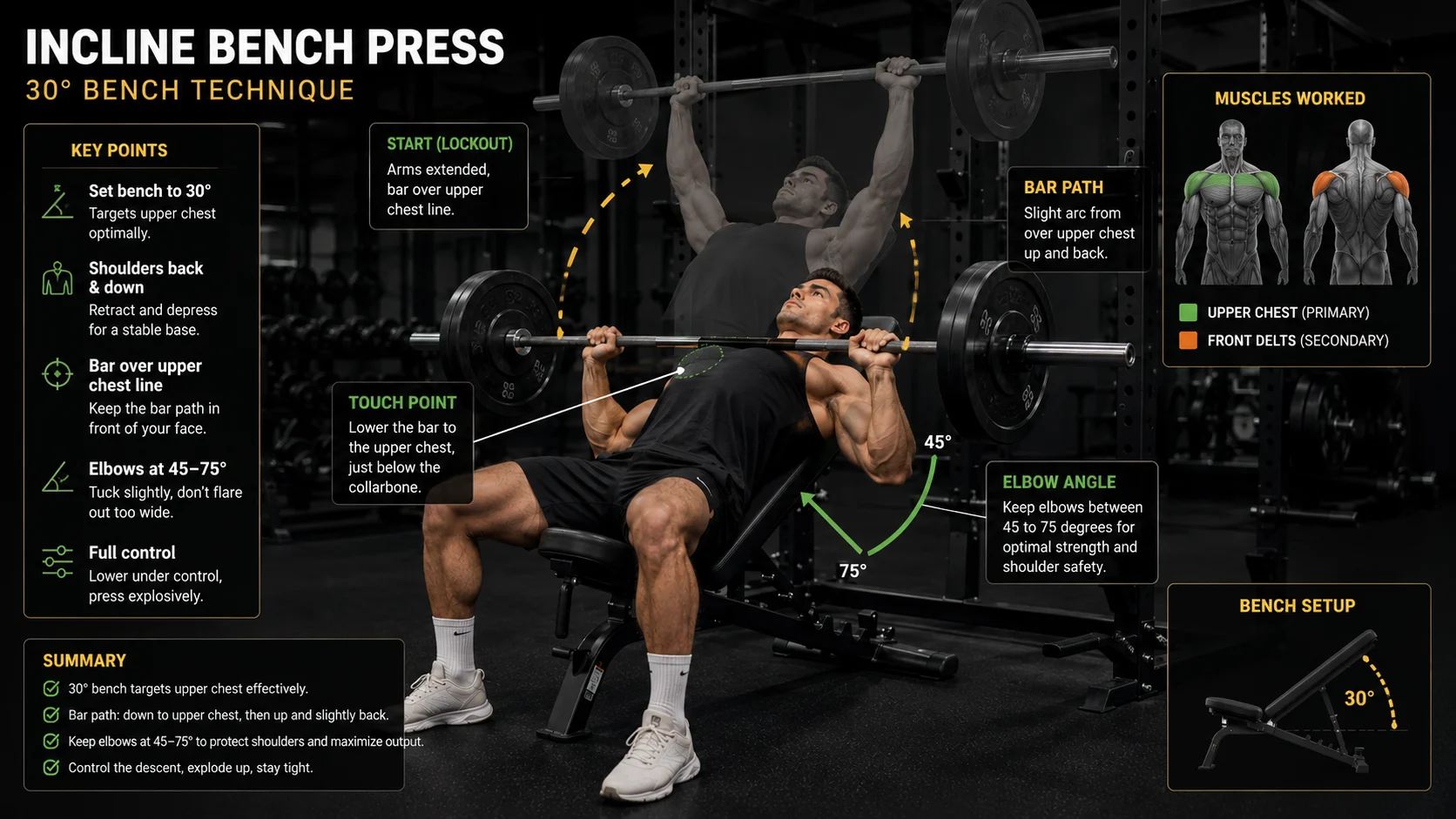 Correct incline bench press position: bar travels from upper chest to directly above the shoulder line at lockout.
Proper Incline Bench Form Checklist
Use this checklist before every working set:
- Bench set to 15-45 degrees (30 degrees is the default).
- Feet flat and stable on the floor.
- Shoulder blades pulled down and back.
- Bar lowered to the upper chest, not the neck.
- Elbows kept in a 45-75 degree path, not flared straight out.
- Full range of motion with controlled tempo.
- Press path slightly up and back toward shoulder line.
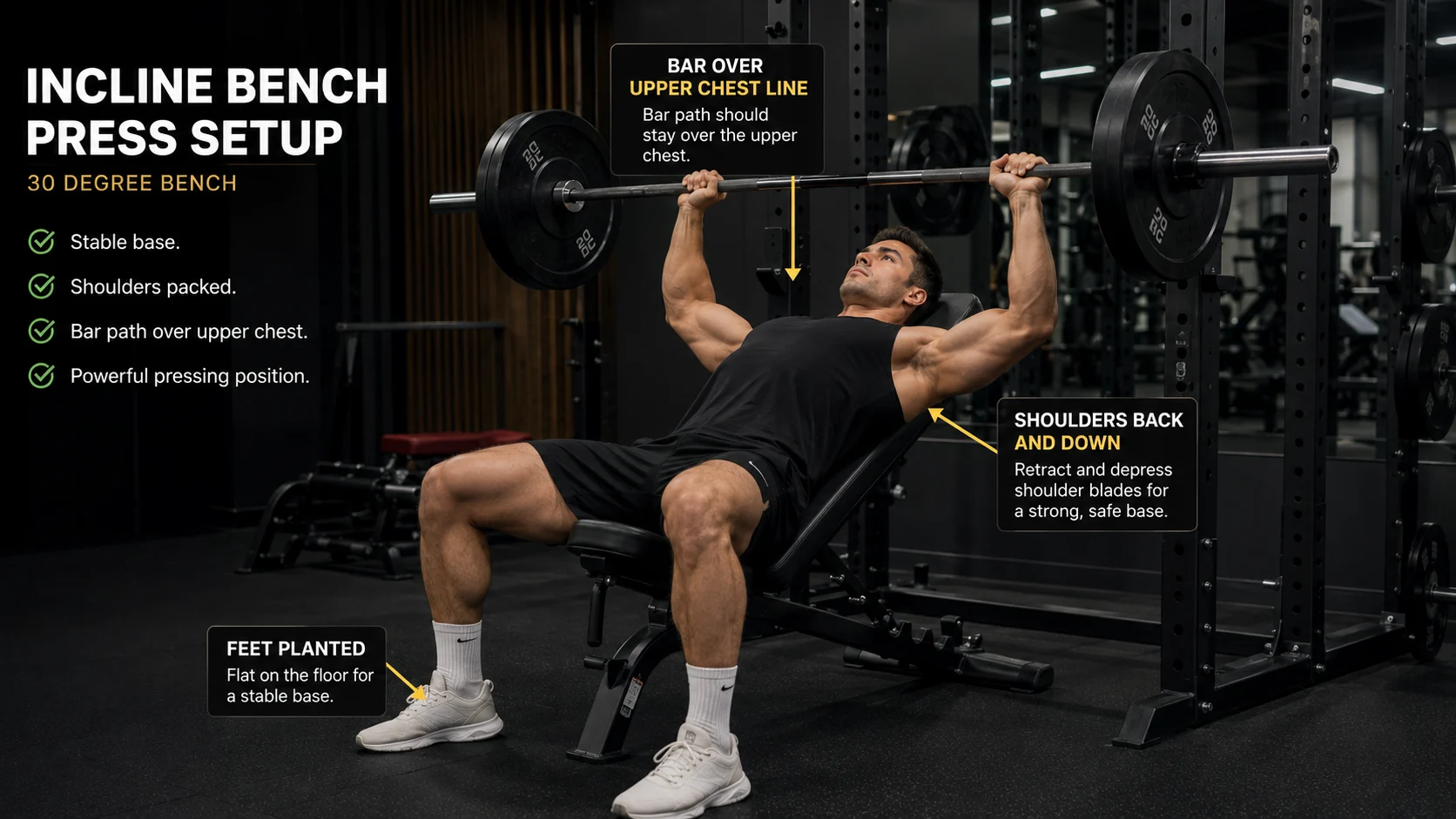 Proper incline bench form: stable base, retracted shoulder blades, and bar path to the upper chest.
Coaching Cues
- “Bar to the upper chest, not the neck.” Keeps the bar path consistent with the incline angle.
- “Elbows at 45, not flared.” Reduces shoulder strain, same as on the flat bench press.
- “Shoulder blades down and back.” Reinforces a stable upper-back base on the angled bench.
- “Drive up and slightly back.” Reinforces an efficient bar path toward the shoulders at lockout.
Common Mistakes
- Setting the bench angle too steep. Why it happens: assuming a steeper angle means more upper chest work. Why it matters: past a certain point, it shifts the exercise increasingly toward a shoulder press rather than a chest press. Fix: start around 30 degrees and adjust based on where you feel the stimulus.
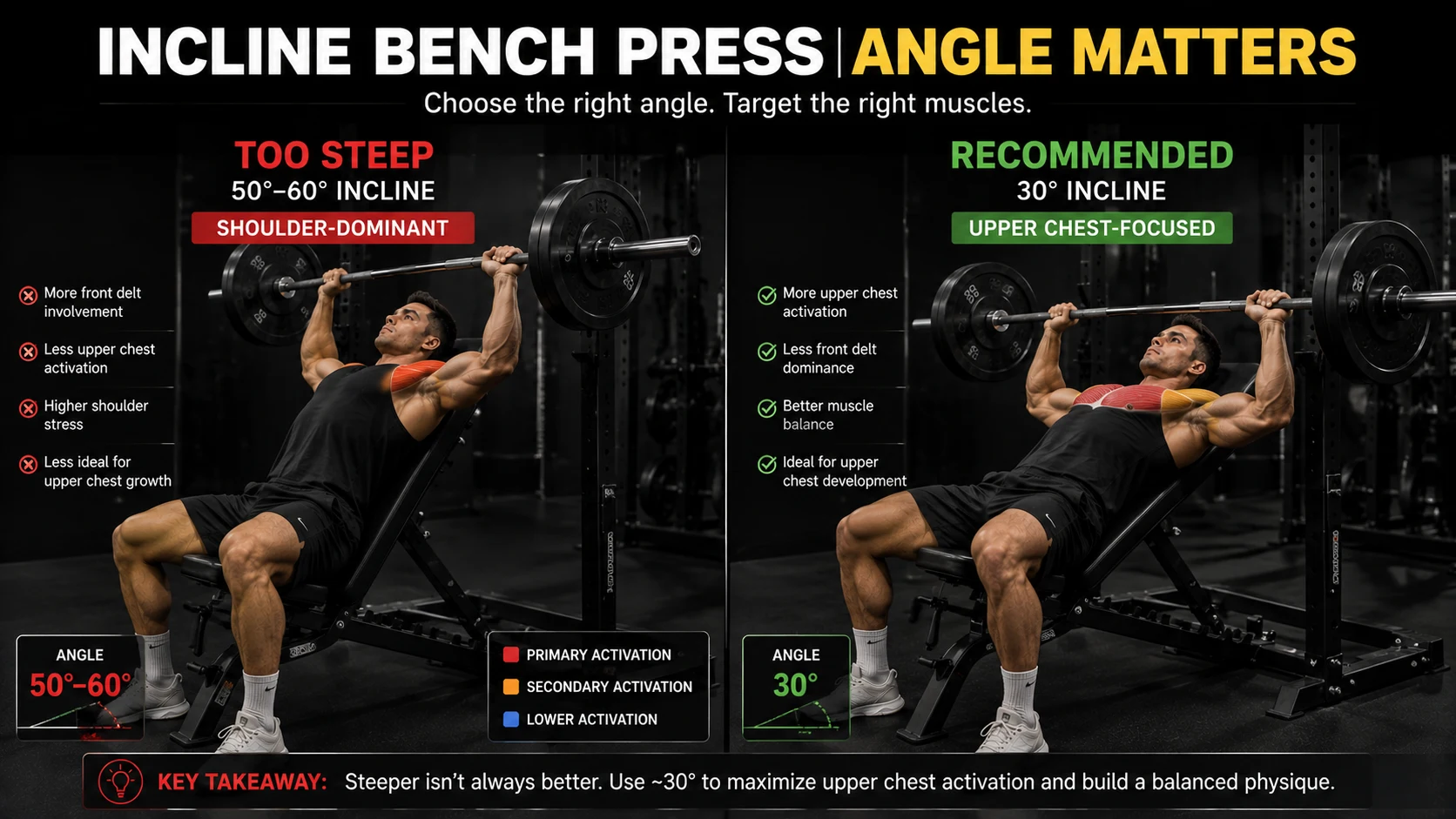 Too steep vs correct: a 50+ degree incline shifts the exercise toward shoulder-dominant pressing and away from upper chest.
-
Flared elbows. Why it happens: feels intuitive under fatigue. Why it matters: increases shoulder joint stress. Fix: keep elbows at roughly 45-75 degrees from the torso.
-
Bouncing the weight off the chest. Why it happens: using momentum to move more weight. Why it matters: reduces the actual muscular stimulus and increases injury risk. Fix: lower under control and press without a bounce.
-
Partial range of motion. Why it happens: lifting heavier weight for a shorter distance feels like progress. Why it matters: under-trains the stretch position at the bottom. Fix: lower to the upper chest consistently every rep.
Breathing
- Before unracking: take a deep breath and brace your core.
- During the descent: hold your breath or breathe out slightly while lowering the weight under control.
- During the press: exhale as you drive the weight upward.
- Between reps: re-brace with a fresh breath before each rep.
Programming
| Goal | Sets | Reps | Rest | Notes |
|---|---|---|---|---|
| Strength | 3-4 | 5-8 | 3 min | Slightly lower load capacity than flat bench at the same effort level |
| Hypertrophy (muscle growth) | 3-4 | 6-12 | 2-3 min | Moderate intensity, close to failure |
| Muscular endurance | 2-3 | 15-20 | 60-90 sec | Lighter load, higher fatigue tolerance |
By experience level:
- Beginners: 2-3 sets of 8-12 reps, 1-2x per week, focusing on consistent bar path before chasing heavier weight.
- Intermediate lifters: 3-4 sets of 6-10 reps, 1-2x per week, using a structured progression method.
- Advanced lifters: Often rotate barbell and dumbbell incline variations across a training cycle to manage joint stress while continuing to progress.
Progressive Overload
When to increase weight: once you can comfortably complete all prescribed sets and reps with 1-2 reps in reserve, add a small increment next session.
When to increase reps instead: if a weight jump isn’t appropriate yet, add a rep to one or more sets at the same weight first.
How to avoid plateaus: track every session’s weight, reps, and sets. For the full six methods of progressive overload, see our complete progressive overload guide. If you want the tracking done for you automatically, Sleet logs every set and shows you exactly when to add weight next.
Variations
| Variation | Purpose | Difficulty | Best For | Pros | Cons |
|---|---|---|---|---|---|
| Dumbbell Incline Press | Independent arm movement | Beginner-Intermediate | Correcting imbalances, greater range of motion | Greater range of motion; addresses asymmetries | Harder to load as heavy as a barbell |
| Low-Incline Press (15 degrees) | Slight upper chest bias | Beginner-Intermediate | Lifters wanting minimal shoulder involvement | Closer to flat bench loading capacity | Less upper chest-specific than a steeper incline |
| Smith Machine Incline Press | Fixed bar path | Beginner | Training safely close to failure alone | Easier to train alone; consistent bar path | Fixed path may not suit every lifter’s shoulder mechanics |
| Incline Dumbbell Fly | Isolation movement at an incline angle | Intermediate | Upper chest isolation | Strong upper chest stretch and isolation | Not a pressing movement; lower loading potential |
Incline Bench Press Dumbbell, Barbell, and Machine Options
If you searched for incline bench press dumbbell, dumbbell incline bench press, db incline bench press, barbell incline bench press, or incline bench press machine, use this quick selection guide:
| Version | Best For | Typical Tradeoff |
|---|---|---|
| Barbell Incline Bench Press | Heavier loading and easier progression tracking | Less freedom to adjust wrist and elbow path |
| Dumbbell Incline Bench Press (DB Incline Bench Press) | Better side-to-side balance and more natural arm path | Harder setup and usually lower absolute loading |
| Smith Machine Incline Bench Press | Stable path, safer solo sets near failure | Fixed bar path may not match your shoulder mechanics |
| Plate-Loaded or Selectorized Incline Press Machine | Simple setup, efficient high-rep hypertrophy work | Less stabilization demand than free weights |
Smith Machine Incline Bench Press Setup
Set the bench so the bar tracks toward your upper chest in the bottom position and toward shoulder line at lockout. For most machines, that means the bench is slightly in front of the bar path, not centered directly below it.
Start with a low-to-moderate incline (about 20-30 degrees) and test one warm-up set. If you feel shoulder pinch at the bottom, lower the bench angle or shift the bench position slightly forward or backward until the path feels smooth.
Alternatives
- Landmine Press: a shoulder-friendly angled pressing alternative that also emphasizes the upper chest and shoulders.
- Incline Push-Up (feet elevated or hands elevated): a bodyweight alternative for home training.
- Incline Dumbbell Fly: an isolation-focused alternative for direct upper chest work.
- Machine Incline Press: a guided, stable alternative that’s easier to train close to failure safely.
How to Do Incline Bench Press Without a Bench
If you do not have an adjustable bench, you can still train a similar pattern:
- Feet-elevated push-ups: place feet on a box or step to bias upper chest.
- Incline push-ups on handles or parallettes: use deep range and controlled tempo.
- Landmine press (single arm or two-arm): naturally follows an upward pressing arc.
- Low-to-high cable press or fly: strong upper chest stimulus with continuous tension.
These alternatives are not exact replacements for heavy barbell incline loading, but they work well for home training or equipment-limited programs.
Incline Bench Press vs Other Exercises
Incline Bench Press vs Flat Bench Press
If your question is “is incline bench press harder than flat,” the answer is usually yes for load. Most lifters use less weight on incline than on flat bench for the same rep target.
| Factor | Incline Bench Press | Flat Bench Press |
|---|---|---|
| Primary emphasis | Upper (clavicular) chest fibers | Overall chest, balanced fiber involvement |
| Typical load | Slightly lighter | Slightly heavier |
| Best for | Upper chest development | General chest and pressing strength |
Incline Bench Press vs Dumbbell Incline Press
| Factor | Barbell Incline Press | Dumbbell Incline Press |
|---|---|---|
| Load capacity | Higher | Lower |
| Stabilization demand | Lower | Higher |
| Best for | Maximal loading | Correcting imbalances, joint comfort |
Incline Bench Press vs Overhead Press
| Factor | Incline Bench Press | Overhead Press |
|---|---|---|
| Pressing angle | Angled (15-45 degrees) | Fully vertical |
| Primary emphasis | Upper chest, some shoulder | Shoulders primarily |
| Best for | Upper chest hypertrophy | Shoulder strength and stability |
Safety
Shoulder pain: Often linked to a bench angle that’s too steep, flared elbows, or inadequate warm-up. Adjusting the angle and correcting elbow position usually resolves most cases.
Spotter and safety pin use: For barbell incline pressing close to failure, use a spotter or set safety pins at an appropriate height, similar to the flat bench press.
Who should avoid or modify the incline bench press: people with an acute, unresolved shoulder injury, or anyone specifically advised against pressing movements by a physiotherapist or physician. A machine incline press or landmine press is usually a more appropriate starting point in these cases.
The Science
EMG studies comparing bench angles generally show increasing upper chest activation as the incline angle increases up to a point, with anterior deltoid involvement rising alongside it.
Hypertrophy research (see our best rep range guide) supports training multiple bench angles across a training block, since the upper and lower chest fibers appear to respond somewhat differently to different pressing angles.
Training volume recommendations for chest, discussed in our sets per muscle group per week guide, apply to incline pressing as part of total weekly chest volume.
What Is a Good Incline Bench Press Weight?
A good incline bench press weight is any load you can control with full range of motion, stable shoulder blades, and no bounce. In practice:
- Beginners should prioritize form and consistency over chasing heavy numbers.
- Many intermediate lifters incline press around 80-90% of their flat bench load for similar reps.
- The right load keeps 1-3 reps in reserve on most working sets.
If your goal is hypertrophy, progressing reps and quality of execution is often more important than adding weight every session.
What Reddit Lifters Report (Anecdotal)
Reddit discussions are not scientific evidence, but they are useful for understanding common real-world experiences and mistakes.
- In this r/naturalbodybuilding discussion on bench press vs incline bench press, a repeated theme is to keep incline if upper chest is lagging, and to use stable variations (barbell, Smith, or machine incline) when dumbbell loading stalls.
- In this r/naturalbodybuilding thread asking if you should only do incline press, many lifters report incline can cover most chest pressing goals, but several still keep dips, flies, and some overhead work to avoid shoulder or chest imbalances.
- In this r/naturalbodybuilding thread on upper chest growth from incline bench, lifters commonly report better upper chest development after prioritizing incline presses (often 15-30 degrees), while maintaining overall chest size by keeping at least some flat or dip volume.
Use these community insights as practical checkpoints, then confirm with your own execution quality, progression data, and shoulder comfort over 4-8 weeks.