Introduction
A workout split is how you organize lifting across the week, including which movement patterns or muscle groups are trained on each day. Most lifters do not fail because they picked a bad split. They fail because the split does not fit their real week, their recovery, or their progression habits.
This guide helps you pick the right split by goal, experience, and weekly availability. You will also find practical examples, common mistakes, and links to deeper programming pages across Sleet.
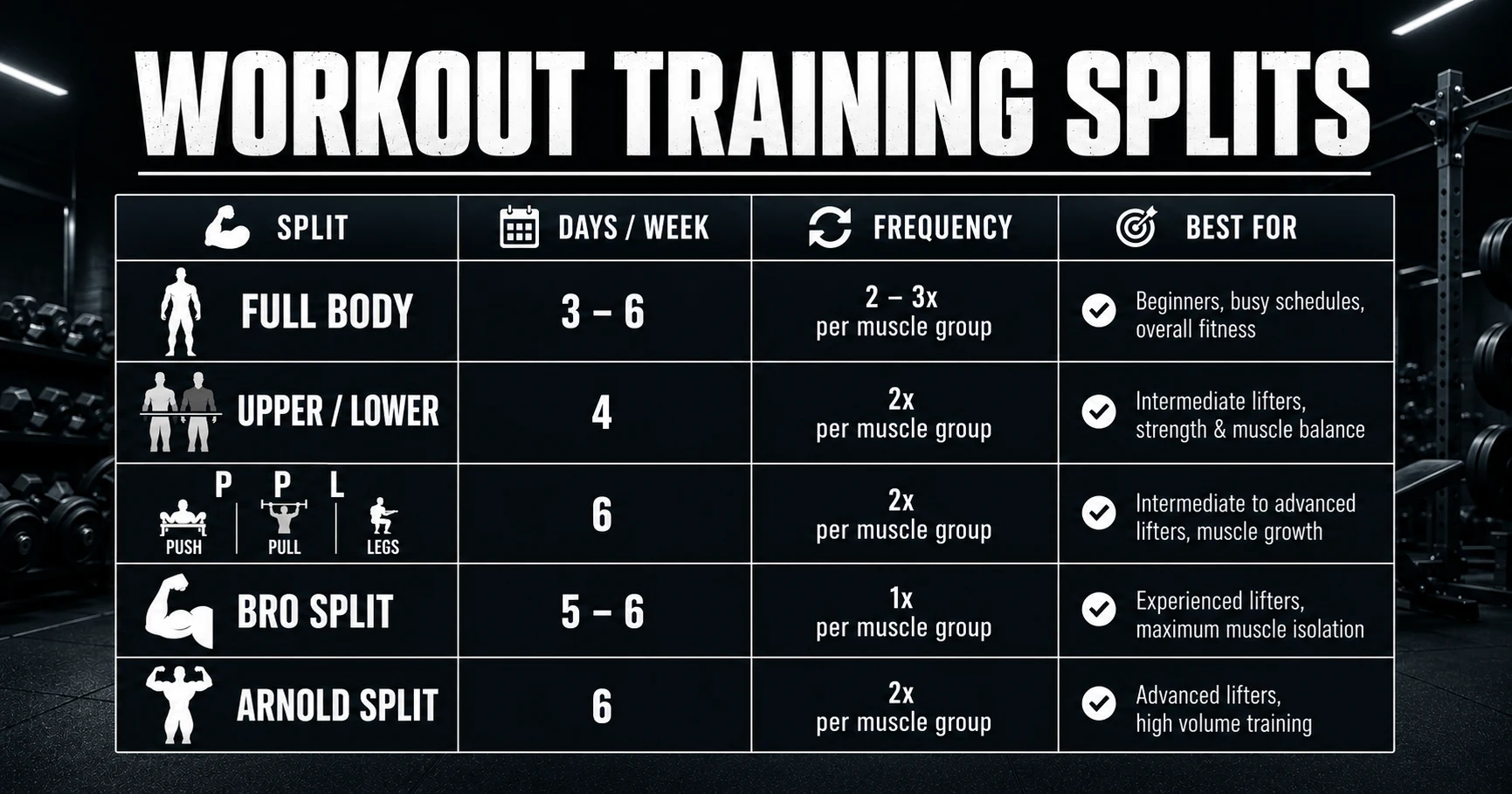
Quick Comparison: Which Split Is Best?
If you only want the short version, use this table first.
| Split Type | Typical Days/Week | Muscle Frequency | Best For | Recovery Demand | Session Length | Beginner Friendly |
|---|---|---|---|---|---|---|
| Full Body | 2-3 | 2-3x weekly | Beginners, busy schedules, fat loss phases | Moderate | Medium | High |
| Upper/Lower | 3-4 | 2x weekly | Intermediate muscle and strength progress | Moderate | Medium | High |
| Push/Pull/Legs (PPL) | 3, 5, or 6 | 1-2x weekly | Intermediate to advanced hypertrophy | Moderate to high | Medium to long | Medium |
| Bro Split (Body Part) | 5 | Usually 1x weekly | Advanced focus work, high per-session volume | High | Medium | Low |
| Arnold Split | 6 | 2x weekly | Advanced hypertrophy with high workload tolerance | Very high | Long | Low |
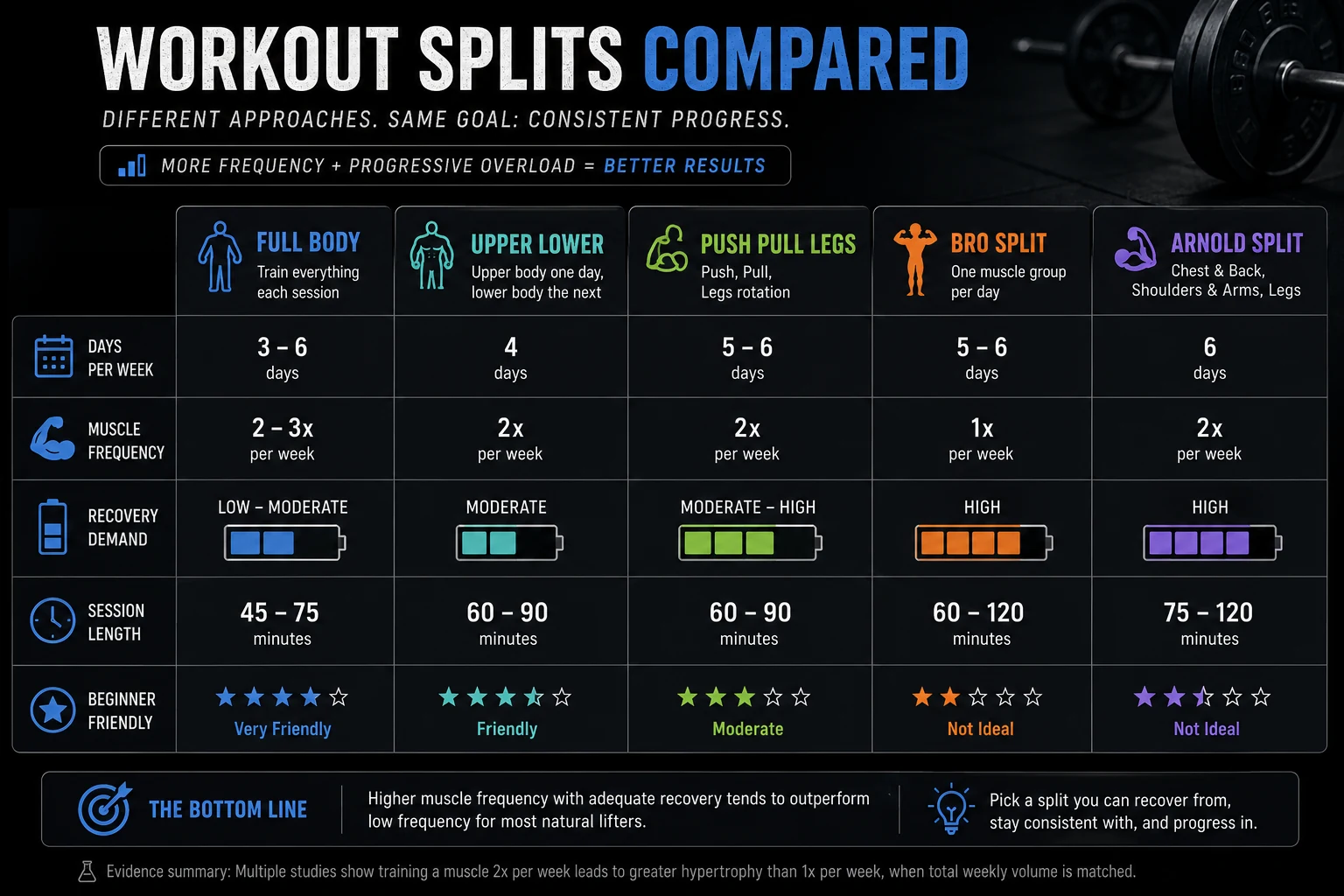
Visual comparison matrix for full body, upper/lower, PPL, bro split, and Arnold split.
What Is the Most Effective Workout Training Split?
The most effective split is the one that lets you complete enough quality sets each week, recover between sessions, and progressively overload your key lifts. For most lifters this means:
- 3-day full body if you are new or inconsistent
- 4-day upper/lower if you are intermediate and want a sustainable default
- 5 to 6-day PPL if your schedule and recovery are reliably strong
If you are forced to skip workouts often, choose the lower-frequency split first and execute it perfectly.
Best Split by Experience Level
Beginner: Full Body (3 Days)
Beginners improve fastest when movement practice is frequent, exercise selection is simple, and recovery is predictable. A 3-day full body split checks all three boxes. You repeat the core patterns multiple times each week, which improves technique quality much faster than once-weekly exposure. That matters because most beginner progress comes from better skill and rep execution, not from highly specialized split design.
Another advantage is error tolerance. If you miss one workout in a 3-day full body plan, you still train every major pattern that week. In higher-fragmented splits, a missed day can mean a full muscle group gets skipped for seven days. For newer lifters balancing school, work, and inconsistent sleep, this reliability is usually the difference between “on paper” programming and real progression in the gym.
A practical target for most beginners is 2 to 4 hard sets per main movement pattern per session, then progressing load or reps gradually while keeping 1 to 3 reps in reserve on most sets. This keeps fatigue controlled while still creating enough weekly volume to build muscle and strength.
Read the full template: Best workout split for beginners. For a barbell-focused 3-day option with built-in linear progression, the 5x5 workout program is one of the most time-tested choices for beginners ready to commit to compound barbell training.
Intermediate: Upper/Lower or PPL
Intermediates usually need more weekly hard sets than beginners to keep adapting, which is where split choice starts to matter more. Upper/lower is often the most sustainable default because it gives two exposures per muscle each week while keeping session structure simple. You can push training quality without turning every workout into a 2-hour session.
PPL becomes attractive when you want more exercise variety, longer accessory work, or additional weak-point focus. The trade-off is that it generally demands tighter schedule consistency and better recovery management, especially in 5 or 6-day setups. If job stress or sleep quality is unstable, upper/lower often outperforms PPL in the real world because completion rate stays higher.
A useful decision rule is this: if you can complete 4 days consistently with strong performance trends, start with upper/lower. If that is stable for multiple months and you still need more quality volume, move to a 5-day or 6-day PPL structure.
Compare both directly: Upper/Lower vs PPL
Advanced: PPL, Bro Split, or Arnold Split
Advanced lifters often benefit from higher total weekly volume, more lift variation, and phase-specific programming. At this stage, split structure is less about “which one works” and more about which one best matches your current objective, fatigue tolerance, and weak-point priorities.
PPL is typically the most flexible advanced base because it supports both moderate and high frequency versions. Bro split and Arnold-style structures can be excellent for focused hypertrophy blocks, especially when you want high per-session local volume and detailed exercise sequencing. The downside is higher systemic and local fatigue, which can hide progression if recovery fundamentals are not tightly managed.
For advanced trainees, the winning split is the one that lets you keep high-effort execution quality for months, not two hard weeks. If load trend, rep quality, and session completion stay strong, the split is doing its job.
Best Split by Goal
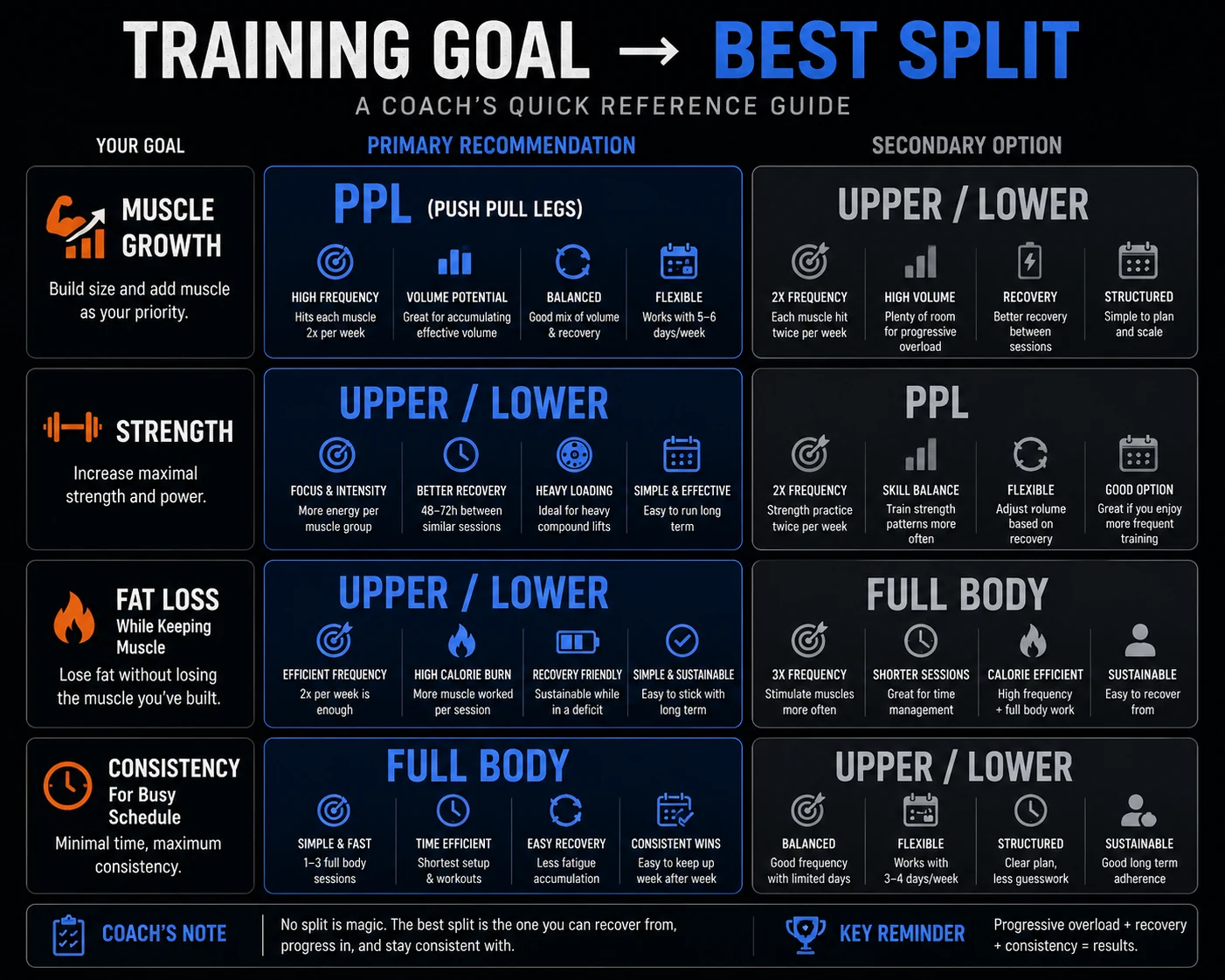
Goal-based split recommendations to speed up split selection and reduce decision fatigue.
Best Split for Muscle Growth
For hypertrophy, the split itself is a delivery system for quality weekly volume. What drives growth is enough hard sets per muscle, consistent proximity to failure, and stable progression over time. Most lifters do best with roughly 10 to 20 hard sets per muscle per week, but that range only works when recovery, exercise selection, and rep quality are under control.
Upper/lower is often the easiest way to distribute this volume with manageable fatigue. PPL becomes useful when you want more exercise slots per muscle and more specialization work. In practice, both can produce similar growth if weekly hard sets and progression quality are matched. The best choice is usually the one you can run consistently for 8 to 16 weeks without frequent missed sessions.
If pumps are high but loads and reps are not trending up over time, the issue is rarely the split label. It is usually too much fatigue, poor progression planning, or poor movement execution.
Supporting guides:
Best Split for Strength
For strength, you need enough lift frequency to refine technique under meaningful load, while keeping fatigue low enough to perform quality top sets. This is why upper/lower is a common default for many strength-focused lifters. It provides repeat exposures on key patterns each week without forcing six training days.
A good strength split also protects your highest-priority lifts by sequencing accessories after main work and managing weekly stress peaks. If your split leaves you too fatigued to perform on core lifts, it is not a strength-oriented setup, even if total weekly volume is high.
Use objective checkpoints: bar speed consistency, rep quality near working maxes, and trend on top-set load at similar RPE. If those improve, your split is supporting strength.
Best Split for Fat Loss While Keeping Muscle
During fat loss, recovery capacity is lower because you are training in a calorie deficit. The best split in this phase is the one that keeps muscle-building tension high while controlling total fatigue. For most lifters, that means 3-day full body or 4-day upper/lower. Both provide enough frequency to preserve muscle without overwhelming recovery.
The common mistake is adding too much training complexity while dieting. High day-count splits can work, but only if sleep, nutrition, and stress are already tightly controlled. For most people, preserving strength on compound lifts and maintaining consistent weekly volume is more important than adding extra sessions.
Think of fat loss training as muscle retention training. Keep lifts hard, technique sharp, and total workload realistic enough that performance does not collapse by week three.
Related reads:
Best Split by Weekly Schedule
3 Days Per Week
Three days per week is the strongest default for lifters who value consistency, have busy schedules, or are still building technical proficiency. The biggest benefit is sustainability. Most people can protect three gym sessions even during high-stress weeks, which means training momentum stays intact.
From a programming perspective, 3-day setups force prioritization. You spend less time on low-value fluff and more time on high-return movement patterns. This usually improves progression quality because effort is concentrated on core lifts and accessories that actually move the needle.
The key is to ensure each session includes meaningful work for squat or knee-dominant patterns, hinge patterns, horizontal or vertical push, and pull variations across the week. If those are covered and load or reps are progressing, three days is enough for excellent long-term results.
- Strong default: full body
- Alternative: rotating upper/lower/full-body hybrid
Program options: 3 day workout split guide
4 Days Per Week
Four days per week is often the best balance between progress potential and recovery reality. It gives enough training slots to increase weekly volume and maintain high-quality exposures on main lifts, but it still leaves room for non-gym life and full recovery days.
Upper/lower is the usual default because it distributes stress cleanly and keeps session focus clear. You can push top sets hard, add targeted accessories, and still avoid the fatigue stacking that often happens in six-day plans for intermediate lifters.
For people who have outgrown beginner volume but cannot reliably train five or six days every week, a 4-day structure usually delivers the highest adherence-to-results ratio.
- Strong default: upper/lower
- Alternative: upper/lower plus specialization focus
Program options: 4 day workout split guide
5 Days Per Week
Five days per week is ideal for lifters who want more targeted work per muscle while still keeping one or two lower-stress days in the week. It creates room for specialization without requiring the very high recovery demands of six straight training days.
This structure works especially well when one or two body parts need extra attention. You can maintain a strong base split while inserting focused volume blocks for lagging areas, as long as total fatigue remains manageable and progression on key lifts stays stable.
The main risk is turning five days into unnecessary volume accumulation. Keep quality high by prioritizing hard, trackable sets and trimming accessories that do not improve performance, execution, or hypertrophy outcomes.
- Strong default: hybrid upper/lower + PPL blend
- Alternative: bro split
Program options: 5 day workout split guide
6 Days Per Week
Six days per week can be extremely productive for advanced lifters, but only when recovery systems are robust and lifestyle stress is controlled. The upside is high weekly frequency, large exercise menu capacity, and strong specialization options. The downside is very small margin for poor sleep, low calories, or inconsistent session quality.
Most successful 6-day setups use repeated PPL or an Arnold-style structure with clear effort distribution across the week. To make them sustainable, you need planned variation in exercise stress, disciplined load management, and readiness to deload before performance trends collapse.
If you routinely miss one of six sessions, you usually get better results by moving back to a high-quality 4-day or 5-day plan. Completion rate beats theoretical volume every time.
- Strong default: PPL repeated
- Alternative: Arnold split
Detailed breakdown: Arnold split guide
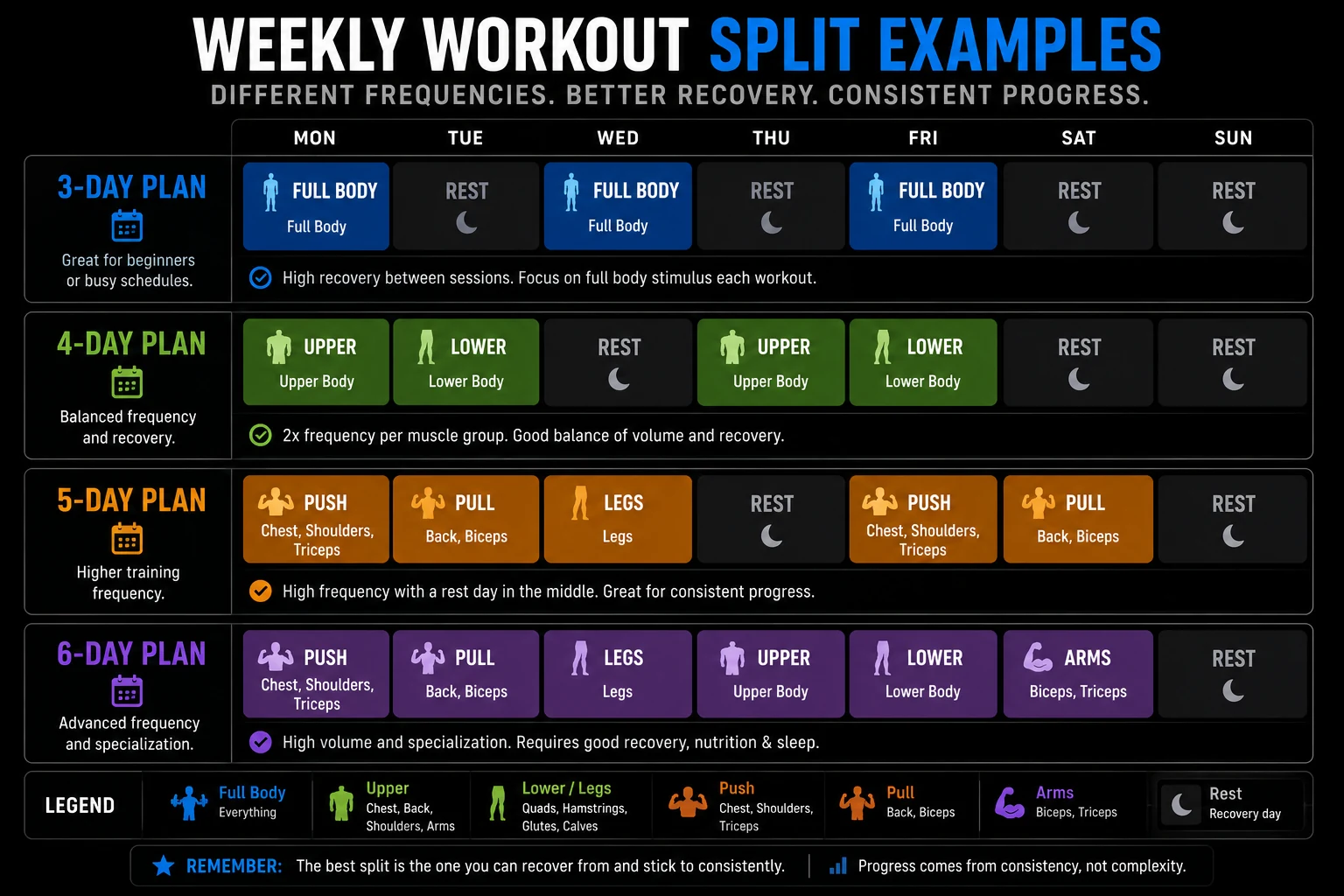
Weekly schedule examples to compare how each split distributes workload and recovery across the week.
Full Body Training
Full body training hits every major muscle group in one session and is usually run 3 times weekly. It is the best default for most beginners because it combines high movement practice frequency with manageable complexity.
See the full beginner full body program
Upper/Lower Split
Upper/lower alternates upper-body and lower-body sessions and is commonly run over 4 days. It is one of the most sustainable split structures for intermediate lifters because it provides twice-weekly frequency with manageable fatigue.
See the complete 4-day upper/lower program
Push Pull Legs (PPL)
PPL organizes training by movement pattern: push, pull, and legs. It can run on 3 days for lower weekly frequency or 6 days for twice-weekly exposure per muscle.
See the complete PPL guide and sample programs
Bro Split (Body Part Split)
The bro split usually trains one muscle group per day over 5 days. It offers very high per-session volume with lower weekly frequency per muscle. It can still produce excellent hypertrophy when effort quality and progression are strong, but it is less forgiving if you miss sessions.
See if the bro split is right for you
Arnold Split
The Arnold split typically pairs chest/back, shoulders/arms, and legs, then repeats. It is high-volume and high-fatigue, so it is best used by advanced lifters with excellent recovery habits and consistent execution quality.
See the full Arnold split program
Common Split Selection Mistakes
- Picking a 6-day split with a 3-day schedule reality
- Changing split structure too often instead of progressing current exercises
- Ignoring recovery signals while adding more weekly volume
- Running high-fatigue splits during poor sleep or high life stress periods
- Not tracking sets, reps, load, and completion rate
Related troubleshooting:
12-Week Progression Framework for Any Split
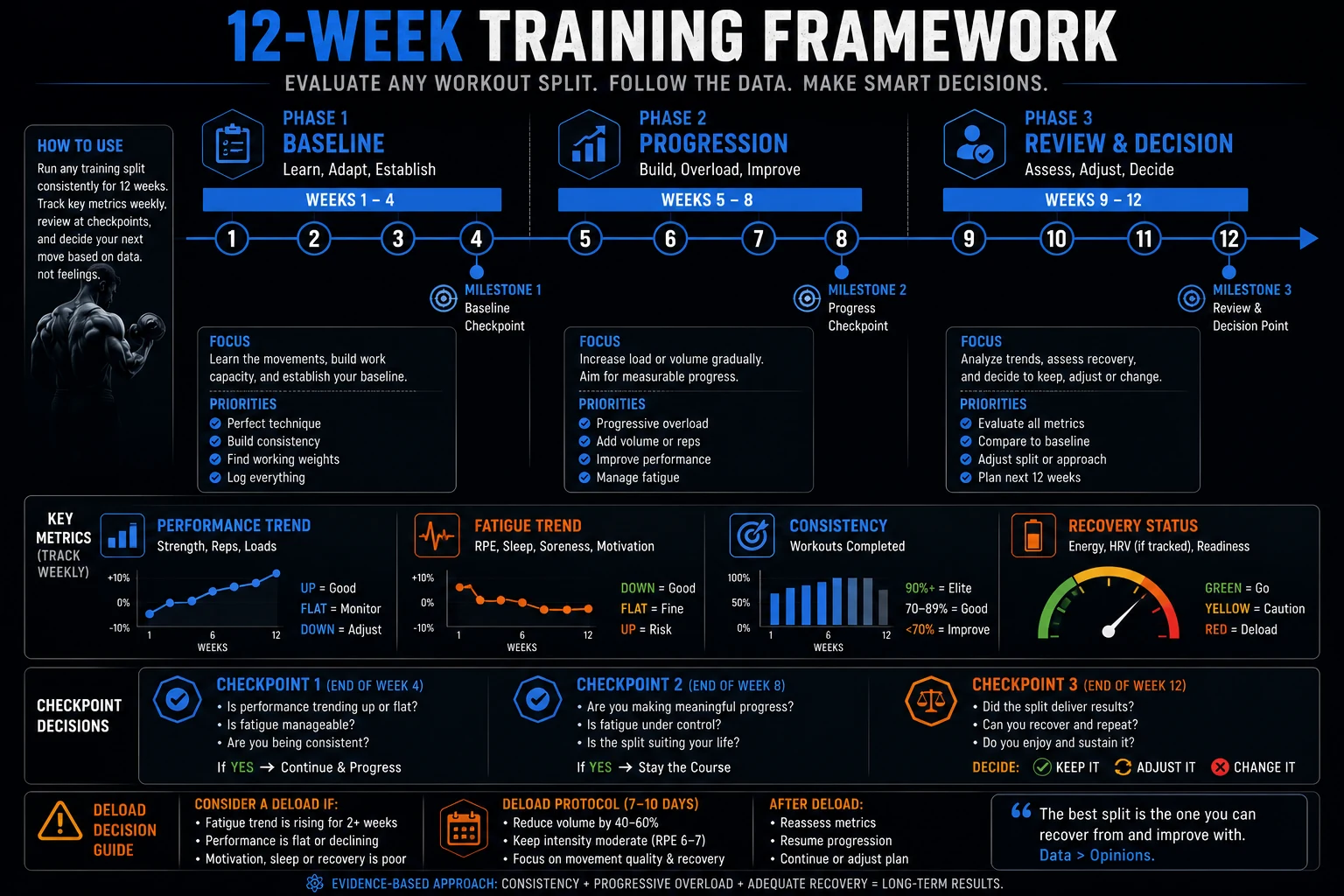
Use this timeline to evaluate progress before changing your split structure too early.
Use this simple framework before deciding to change split structure:
- Weeks 1 to 4: Stabilize exercise selection and establish baseline loads.
- Weeks 5 to 8: Progress load, reps, or sets while maintaining rep quality.
- Weeks 9 to 12: Evaluate performance trend, fatigue trend, and adherence.
- Deload if fatigue is high, then continue same split or switch only if objective data supports change.
Helpful tools:
How to Choose Your Split in 60 Seconds
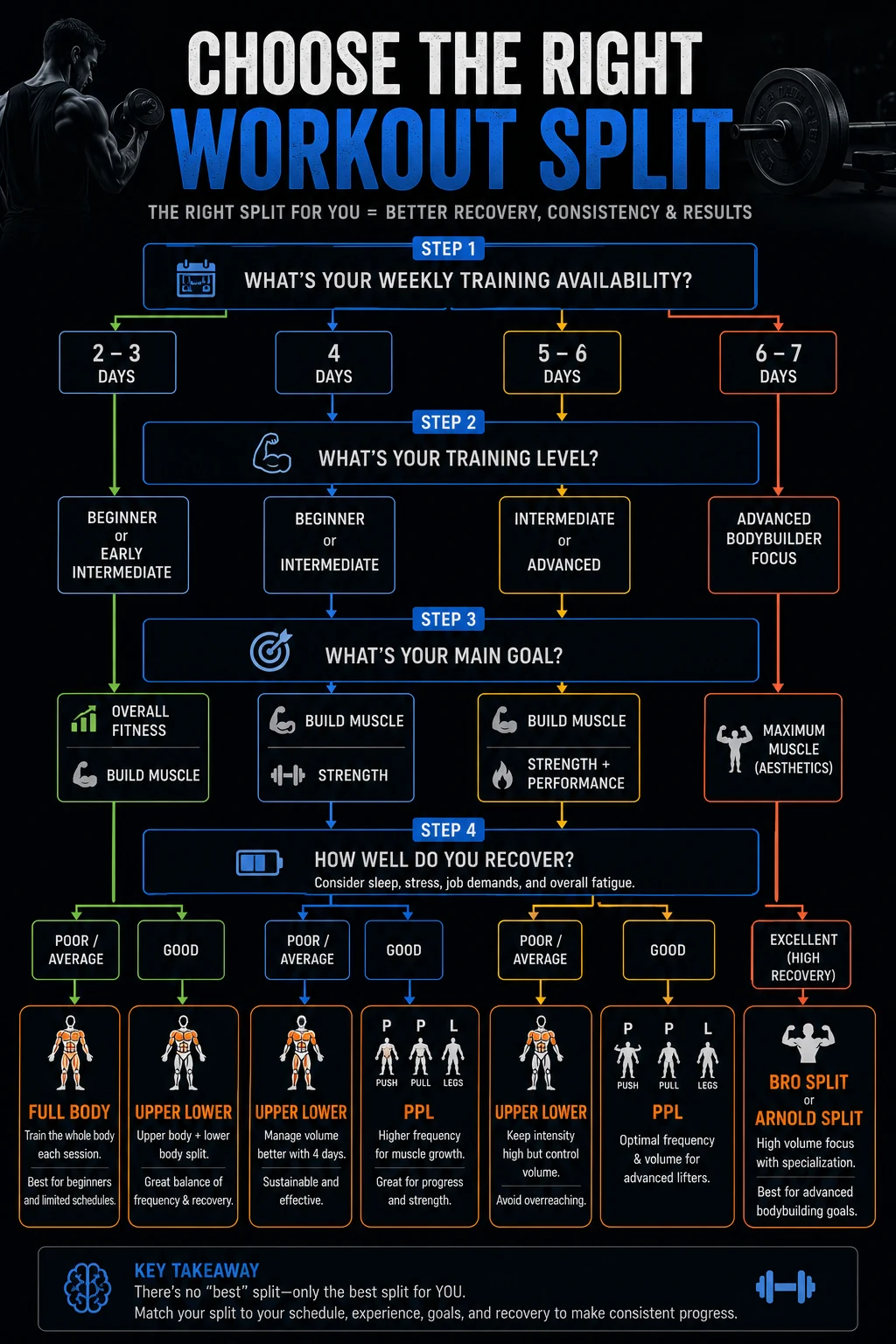
Fast decision tree to choose a split that matches real-life schedule and recovery ability.
Use this order:
- Choose days you can commit to every week.
- Match split type to experience level.
- Match split to primary goal.
- Set weekly volume per muscle.
- Track and review every 4 weeks.
Full decision process: How to choose the right workout split
Quick Program Picks
- Best beginner default: Best workout split for beginners
- Best 3-day options: 3 day workout split guide
- Best 4-day options: 4 day workout split guide
- Best 5-day options: 5 day workout split guide
- Best PPL deep dive: Push pull legs complete guide
- Best decision framework: How to choose workout split
Update Log
- Updated on 2026-07-27: Added comparison matrix, goal-based recommendations, day-based split picks, expanded FAQ coverage, and 12-week progression framework.
Tracking Your Split
Your split does not create progress by itself. Your execution does. Track every working set, rep, load, and perceived effort so progression decisions are based on evidence, not memory.
If your trend is up and recovery is stable, keep the split. If performance is flat while fatigue and inconsistency are rising, adjust volume, recover better, or switch structure.
The easiest way to stay consistent with this is an app that logs everything. Sleet tracks your sets, reps, and weights and shows your progress across every split, free on Android.