Introduction
Walk into any gym and you will notice the same pattern: the person benching 225 lbs on the flat bench moves to the incline bench and suddenly struggles with 165. They are not getting weaker between sets. The incline bench is genuinely harder, and there are clear, well-understood biomechanical reasons for it.
This guide explains exactly why incline bench press is more difficult than flat bench, what is happening in your muscles and joints at that angle, and how to train smarter once you understand the difference. For a broader look at chest development in general, see our lower chest workout guide and why you should not overlook lower chest training for the other end of the spectrum.
The Short Answer
Yes, incline bench press is harder than flat bench for most lifters.
At a standard 30–45 degree incline, you are effectively removing your strongest pressing muscles from their most powerful position, shifting work onto smaller supporting muscles, and changing the mechanical advantage of the shoulder joint. The result is a predictable, structural reduction in how much weight you can move, not a sign of weakness, but a direct consequence of physics and anatomy.
Why Is Incline Bench Harder? The Biomechanics Explained
1. The Lower Pec Contributes Less at an Incline
The pectoralis major is not a single uniform muscle. It has two main heads:
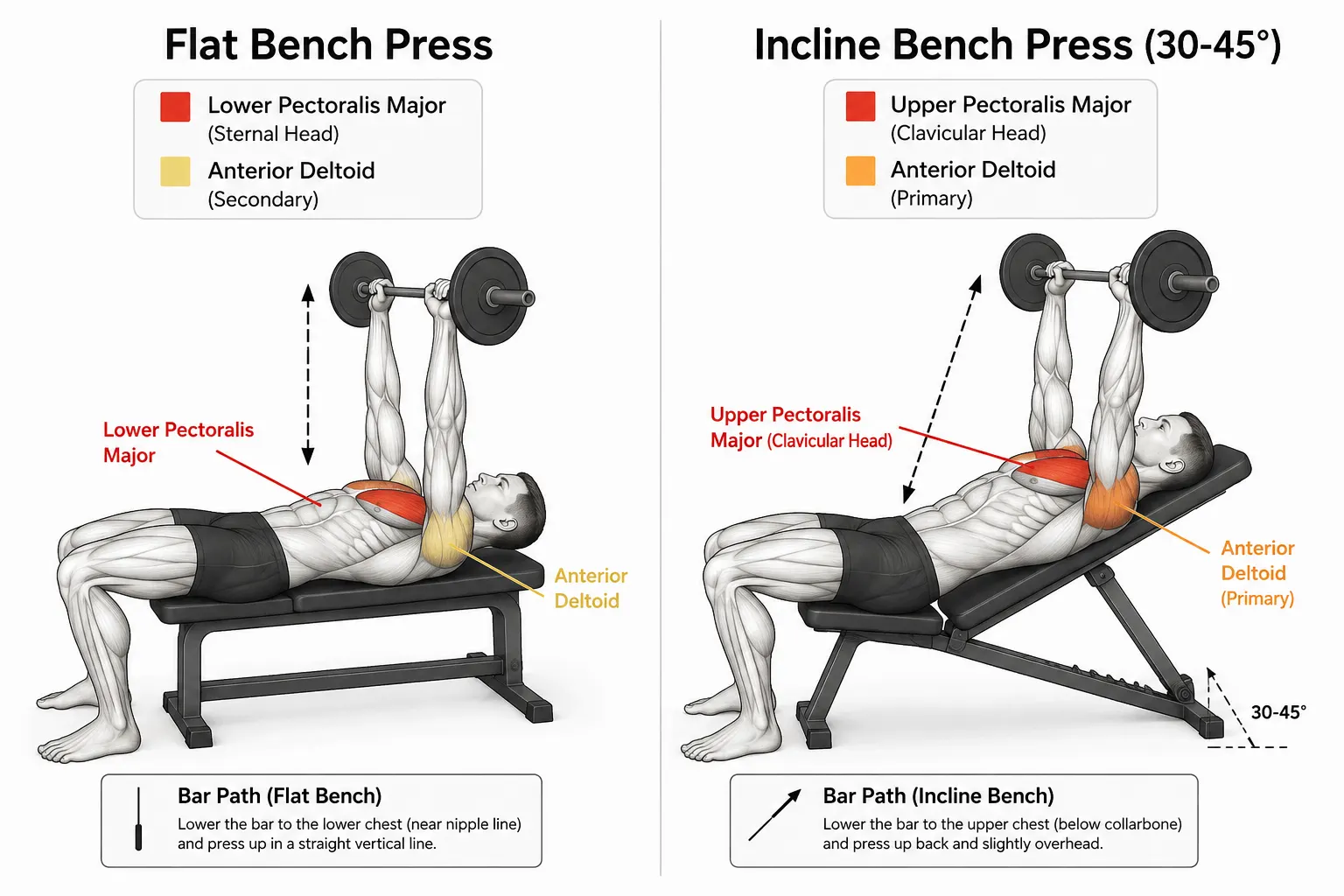
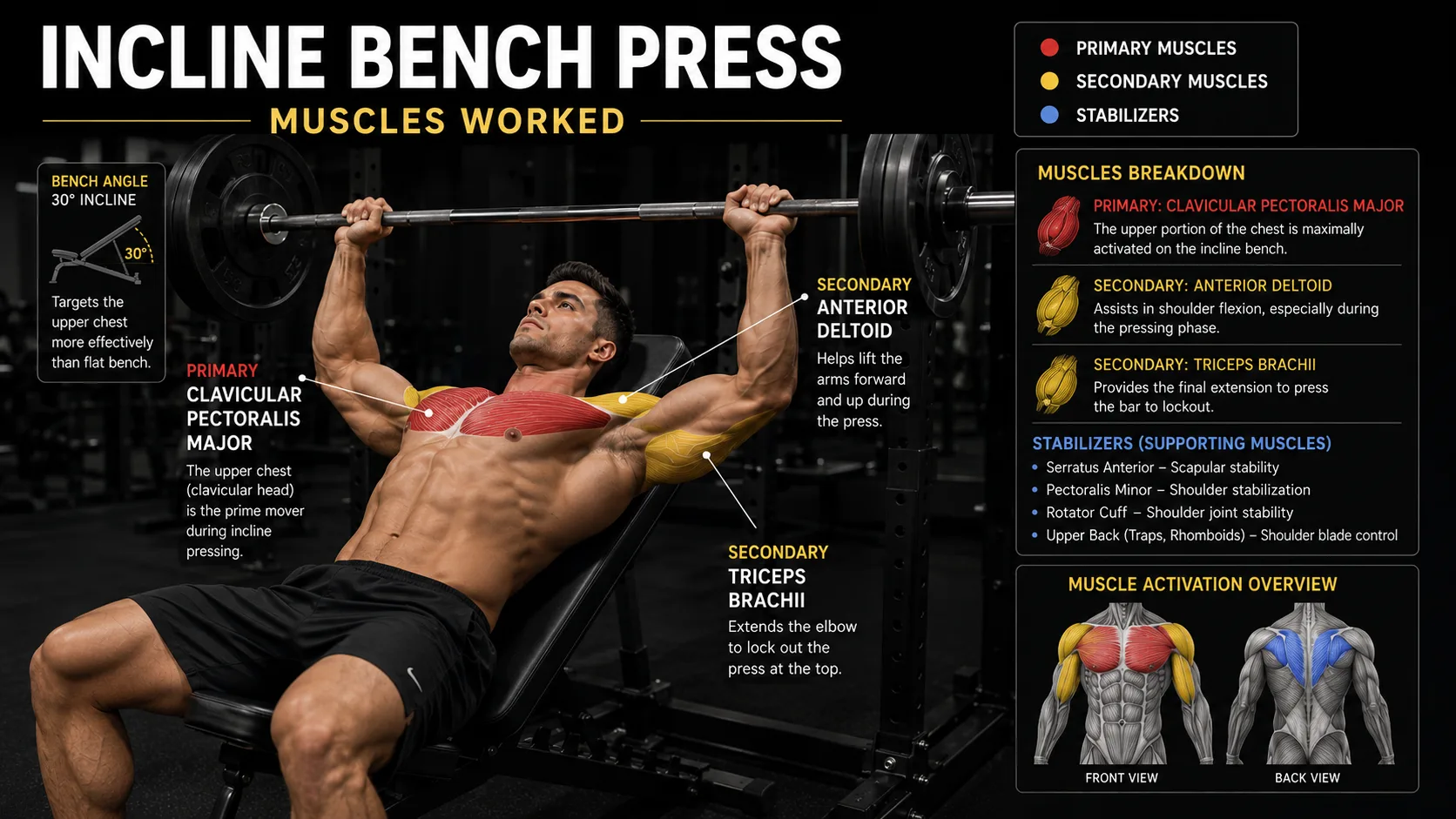
- Sternal (lower) head: The larger head. Makes up the bulk of pectoral mass and produces the majority of pressing force.
- Clavicular (upper) head: The smaller head. Its fibers run at a different angle, making it more active when the arm moves in an upward arc, exactly what happens at an incline.
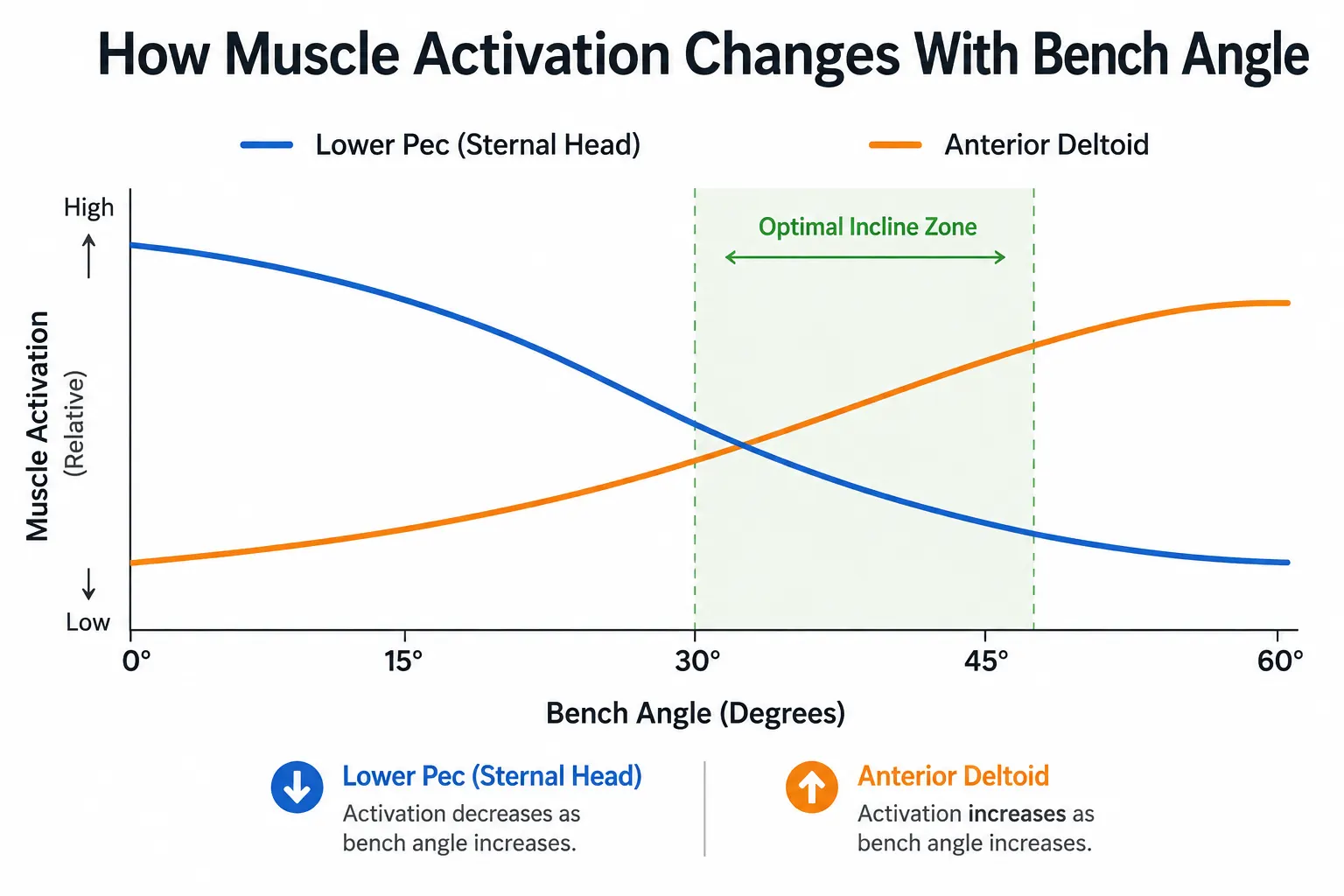
On a flat bench, both heads contribute to the press, with the sternal (lower) head doing the heavy lifting. Tilt the bench to 30–45 degrees and the sternal head’s contribution drops significantly. You are now relying more heavily on the clavicular (upper) head, which is a smaller muscle with less total force-production capacity.
This structural shift is the primary reason your incline numbers are lower. You are not weaker, you are using less of your strongest muscles.
2. The Anterior Deltoid Takes Over
As the bench angle increases, the anterior deltoid (front of the shoulder) takes on a much larger share of the pressing load. This research by Barnett et al. examined EMG activity across flat, incline, and decline bench press variations and found that incline bench significantly increased anterior deltoid activity compared to flat bench.
The anterior deltoid is a smaller muscle than the pectoralis major. More load on a smaller muscle means less total output, directly lowering how much you can lift.
3. The Shoulder Joint Is at a Mechanical Disadvantage
On a flat bench, the shoulder joint is positioned in a way that allows the chest and shoulder muscles to produce force efficiently through a natural pressing arc. At an incline, the joint angle changes the length-tension relationship of the pec fibers and puts the shoulder in a less favorable position for maximal force production.
Think of it this way: you are asking the same muscles to work at an angle where they are inherently weaker. The absolute strength output drops even if the muscles themselves are the same.
4. The Bar Path Is Longer and Less Forgiving
On a flat bench, the bar travels through a relatively short, direct arc. On an incline, the bar path becomes longer and the margin for error in technique increases. A slight deviation in bar path, elbow flare, or scapular position shows up more clearly on incline because there is less mechanical buffer from the large lower pec doing the work.
What the Research Says
Research by Lauver et al. published in the Journal of Human Kinetics compared bench press performance and muscle activation across four angles: 0, 28, 44, and 56 degrees. The study found that upper pectoralis activation peaked around 44 degrees, while steeper angles shifted activation increasingly toward the anterior deltoid. Critically, total pressing output declined as the angle increased, confirming what most lifters experience in practice.
This is a key insight: there is a sweet spot around 30–45 degrees where incline bench effectively targets the upper pec before the exercise starts becoming more of a shoulder press than a chest press.
How Much Weaker Is Incline vs Flat?
For most trained lifters, the incline bench is roughly 20–30% lower than flat bench. Here is a rough reference:
| Flat Bench (lbs) | Expected Incline Range |
|---|---|
| 135 | 95–110 |
| 185 | 130–150 |
| 225 | 160–180 |
| 275 | 195–220 |
| 315 | 220–255 |
These are estimates, not rules. Use the Strength Standards Calculator to see exactly where your numbers land relative to your training level. Lifters who train incline consistently and frequently will close this gap over time. Lifters who only ever flat bench will tend toward the lower end of the incline range because their upper pec is undertrained.
The Upper Pec Is Undertrained by Default
Most gym programs are built around flat bench as the primary chest movement. This means the sternal (lower) pec gets trained heavily and frequently, while the clavicular (upper) pec receives far less direct stimulus over months and years of training.
When you go to incline bench, you are asking an undertrained muscle to be the primary mover. Of course it feels harder, it has not received the same training volume as the lower pec fibers.
Schoenfeld’s foundational research on hypertrophy mechanisms makes clear that muscle growth is driven by mechanical tension, and a muscle that rarely experiences direct loading will remain underdeveloped relative to one that is trained consistently. The upper pec is a classic example of this in practice: it will grow when you train it consistently with progressive overload and adequate weekly sets, but it will stay behind if you only bench flat.
Flat vs Incline: What Each Does
| Factor | Flat Bench | Incline Bench |
|---|---|---|
| Primary mover | Lower/sternal pec | Upper/clavicular pec |
| Anterior deltoid involvement | Moderate | High |
| Absolute load capacity | Higher | 20–30% lower |
| Upper chest development | Minimal | Strong |
| Lower chest development | Good | Minimal |
| Shoulder joint stress | Moderate | Slightly higher |
| Beginner-friendliness | Higher | Moderate |
Neither variation is superior. Both are necessary for complete chest development, see the full incline bench vs flat bench comparison for a head-to-head breakdown. Using flat bench alone leaves the upper chest underdeveloped, which shows up clearly in terms of aesthetics (a less full, top-of-chest look) and in any pressing movement that requires anterior deltoid and upper pec coordination.
Common Mistakes on Incline Bench That Make It Even Harder
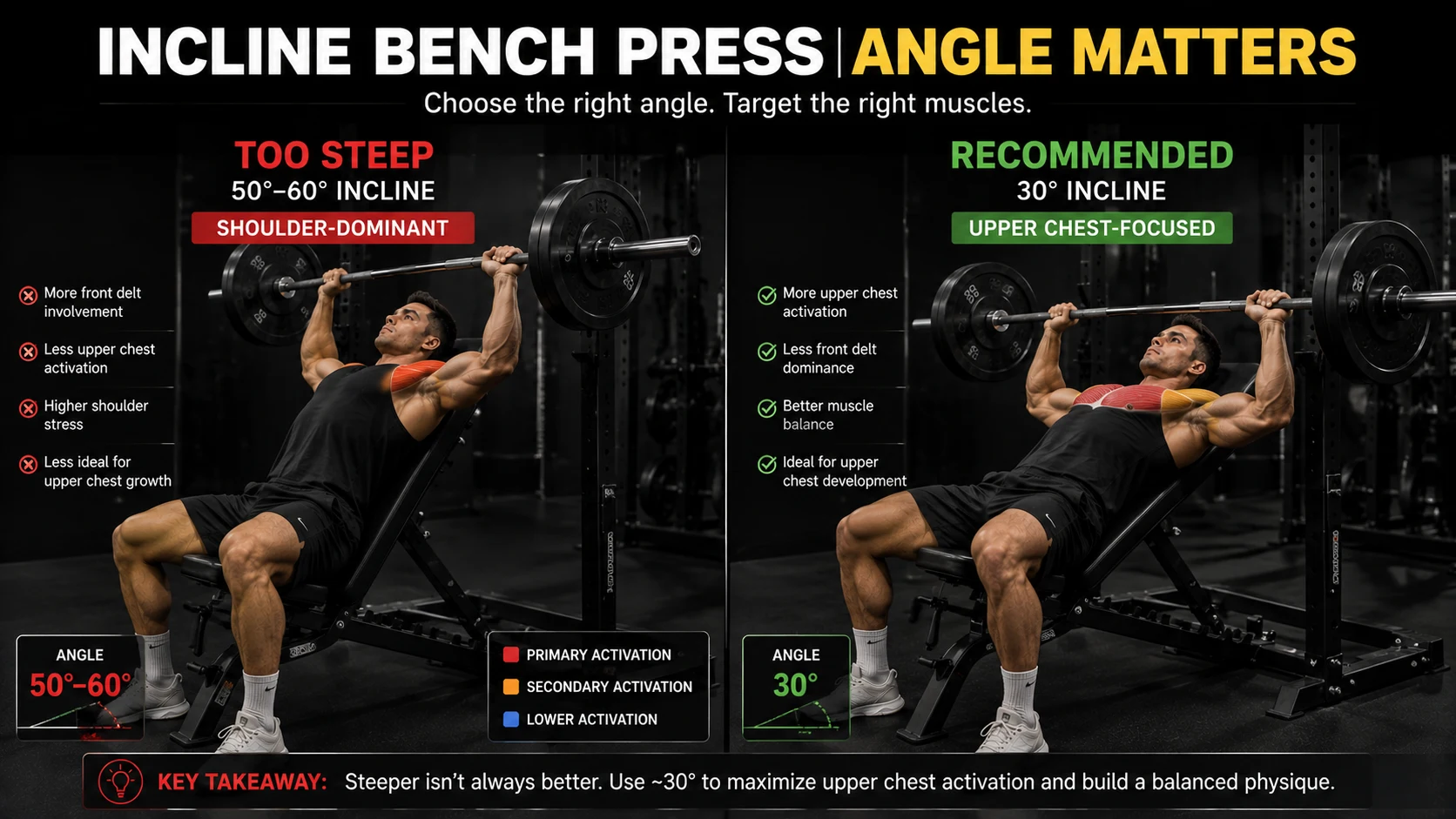
Bench Angle Too Steep
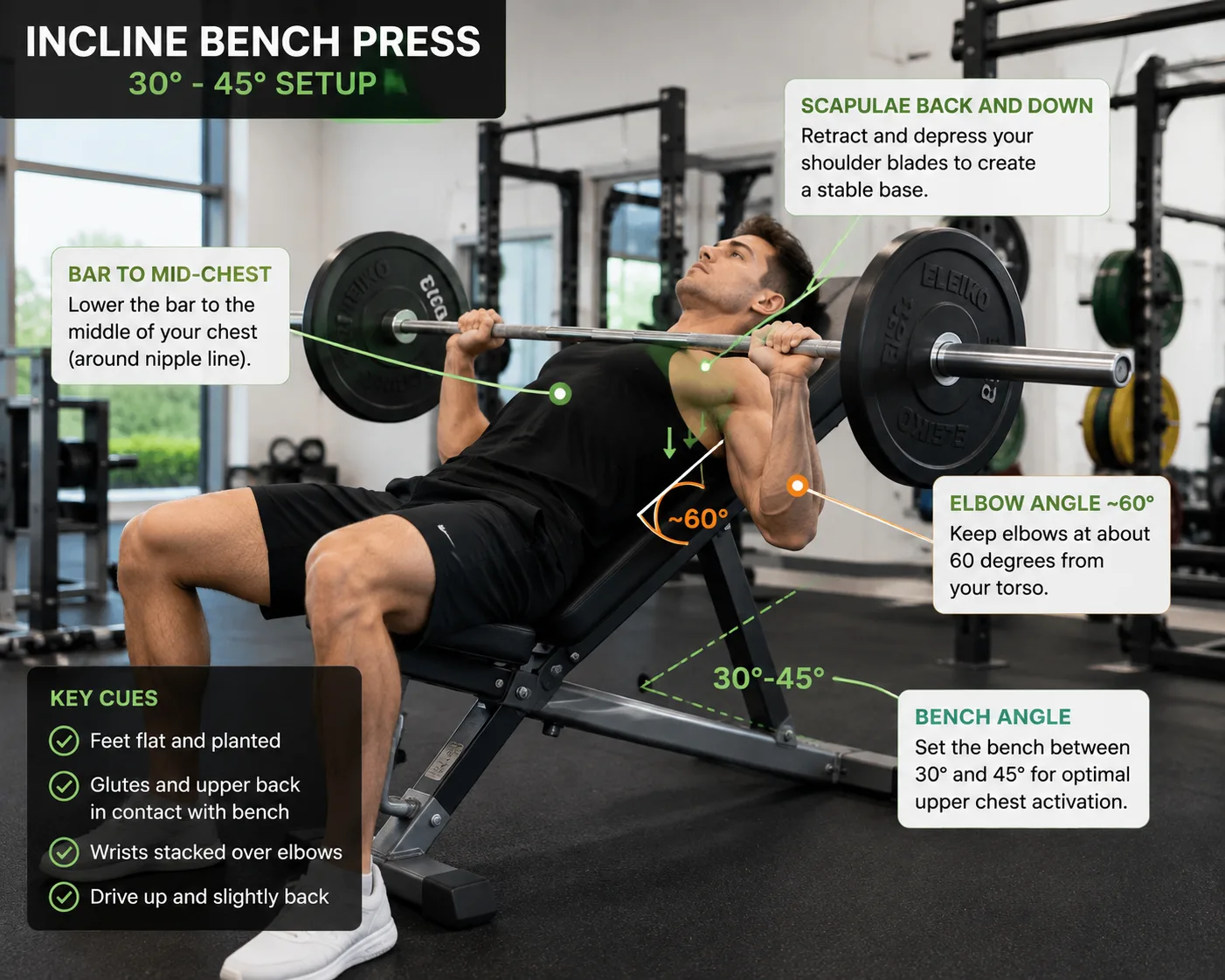
The single most common error. Setting the bench above 45 degrees dramatically reduces pec involvement and turns the movement into a front-delt-dominant press. Use 30–45 degrees. Most adjustable benches have a clear 30-degree or 45-degree setting, use one of those.
Not Retracting the Scapulae
On flat bench, most lifters naturally arch and retract their shoulder blades to create a stable pressing platform. On incline, many lifters forget this and press with protracted, unstable shoulders. This weakens your pressing base, increases shoulder stress, and reduces chest engagement. Set your scapulae back and down before every set.
Grip Width Too Wide
A wider grip on incline increases the range of motion while reducing your mechanical advantage at the top and middle of the press. A moderate grip width, roughly the same as flat bench or slightly narrower, works better for most lifters on incline.
Flaring the Elbows
Elbows flared out to 90 degrees on incline places the shoulder joint under significant stress at an already mechanically challenging angle. Keep elbows at roughly 45–75 degrees from the torso depending on your anatomy, enough to clear the ribs but not so wide that your shoulder is the limiting factor before your chest.
Trying to Lift the Same Weight as Flat
Programming incline at the same load as flat bench is a setup for failure. Accept the 20–30% reduction, apply progressive overload properly to the incline separately, and track the two lifts independently. For a structured way to build both lifts over time, the double progression method works particularly well for incline bench.
How to Get Better at Incline Bench
1. Train It Consistently at Least Twice Per Week
The upper pec responds to frequency and volume like any other muscle. If you are currently doing incline bench once per week or not at all, doubling the frequency is the single highest-leverage change you can make, see the workout frequency guide for how to structure this across your full program. Keep total volume manageable using the Weekly Training Volume Calculator so you are not adding unsustainable fatigue.
2. Use the Right Angle
Set the bench to 30–45 degrees every time. Do not let a crowded gym push you into pressing at 60 degrees and wondering why it destroys your shoulders and barely grows your chest.
3. Apply Progressive Overload to Incline Specifically
Track your incline numbers separately from flat bench and apply structured progression to them independently. Our guide on progressive overload for bench press covers the specific strategies that transfer directly to incline. The One Rep Max Calculator lets you estimate your incline 1RM from any working set, giving you a benchmark to track improvement. The Progressive Overload Calculator can help you build a week-by-week plan for the incline lift specifically.
4. Add Supporting Work for the Anterior Deltoid and Upper Pec
Since the front delt limits incline performance, directly training the anterior deltoid with overhead pressing, front raises, or landmine press can close your incline-to-flat gap faster. This also reduces the likelihood of your shoulders being the weakest link when pressing at an incline angle.
5. Accept the Timeline
Upper pec development takes time. Expect 8–12 weeks of consistent, programmed incline work before you see a meaningful improvement in your incline-to-flat ratio. If your incline stalls, the same principles that apply to any bench press plateau apply here, check frequency, weak points, technique, and accumulated fatigue. A short deload week is often the fastest way to confirm whether fatigue is the bottleneck.
Should You Prioritize Flat or Incline?
This depends on your goal:
For raw strength (powerlifting): Flat bench is the competition lift. Prioritize it. Add incline as a supplementary pressing movement to build upper chest and anterior deltoid strength without neglecting the competition movement.
For muscle development (bodybuilding/aesthetics): Both matter. A chest program built entirely around flat bench produces a lower pec that can appear overdeveloped relative to a flat or underdeveloped upper pec. Including incline as either the first or second pressing exercise in your session, trained in the optimal rep range for hypertrophy, creates more balanced, complete chest development over time.
For general fitness: Flat bench is the more time-efficient primary choice given its higher load capacity. Adding incline as a secondary movement, even once per week, provides meaningful upper chest stimulus and adds variety. For guidance on overall program structure, see our guide on choosing the right workout split.
Practical Tips
- Set the incline between 30 and 45 degrees every session. Use the same angle consistently to make progress comparable.
- Retract and depress your scapulae before every set, exactly as you would on flat bench.
- Track flat and incline press separately. Trying to manage them as a single number obscures where progress is actually happening.
- Give dedicated incline training 8–12 weeks before drawing conclusions about your upper chest response.
- If incline consistently feels like a shoulder exercise rather than a chest exercise, lower the angle and check scapular retraction first before changing anything else.
- For a realistic view of how long muscle development takes when training properly, see our article on how long it takes to build muscle.
Summary
- Incline bench press is harder than flat bench for most lifters because the lower pec fibers contribute less, the anterior deltoid takes on more load, and the shoulder joint is at a mechanical disadvantage at incline angles.
- This is structural and normal, not a sign of weakness. Most trained lifters press 20–30% less on incline than flat.
- The sweet spot for incline pressing is 30–45 degrees. Steeper angles shift the exercise toward a shoulder press.
- The upper pec is chronically undertrained in most programs, making incline feel extra hard until you give it dedicated, consistent work.
- Track flat and incline bench separately, apply progressive overload to each independently, and give upper pec development the time it needs, typically 8–12 weeks to see a meaningful shift.